
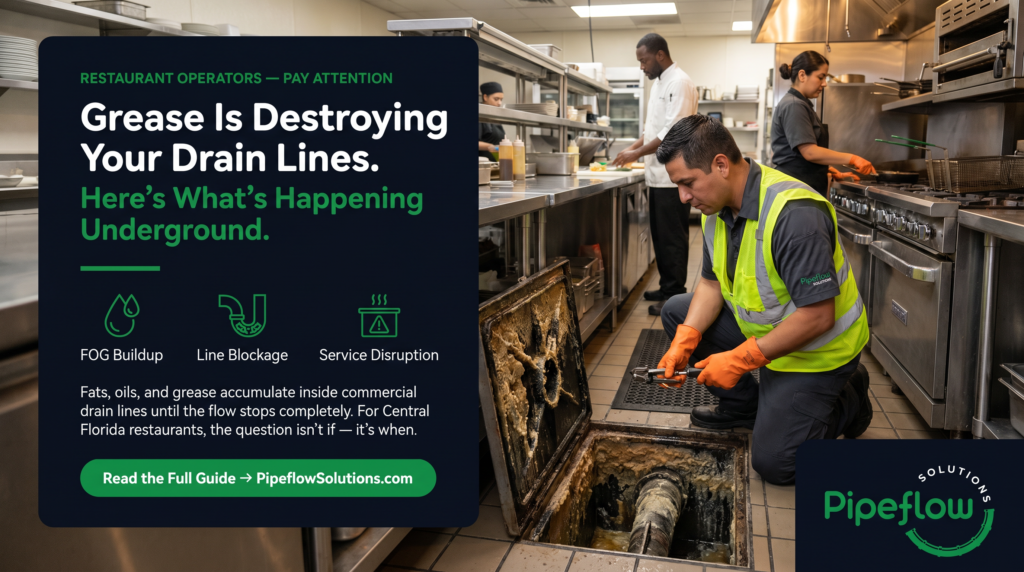
For a restaurant, a drain line failure isn’t a plumbing inconvenience — it’s a revenue event. When a commercial kitchen’s drains back up, the kitchen stops. Health code compliance is instantly at risk, service grinds to a halt, and every hour the line is down is an hour of lost covers you don’t get back. And the single most common cause of that failure, across virtually every commercial kitchen in Central Florida, is grease.
Fats, oils, and grease — known collectively in the industry as FOG — are the defining enemy of commercial kitchen drain systems. Every food service operation generates them, every drain line carries them, and left unmanaged, they will eventually choke a line to the point of failure. The good news is that grease-related drain failure is one of the most predictable and preventable problems in commercial plumbing. Understanding how grease destroys a line, and what a real maintenance program looks like, is what separates operators who deal with emergency backups from those who don’t.
How Grease Actually Destroys a Drain Line
The mistake most operators make is thinking of grease the way it looks coming off a hot pan — as a liquid. In the kitchen, at operating temperature, fats and oils flow freely down the drain. But the moment that warm, liquefied grease hits the cooler interior of a drain line, it begins to cool, congeal, and adhere to the pipe wall. What went down as a liquid becomes a solid coating inside the pipe.
That coating doesn’t wash away with the next rinse. It accumulates. Each service adds another layer, and over weeks and months the effective diameter of the pipe narrows as grease builds up along the walls the way plaque builds in an artery. Compounding the problem, that grease layer isn’t smooth — it’s sticky and irregular, which means it captures food particles, coffee grounds, starches, and other debris moving through the line, accelerating the buildup further. A pipe that started at four inches of clear diameter can be reduced to a fraction of that before anyone in the kitchen notices a problem, because the drain keeps working — slower and slower — right up until the moment it doesn’t.
There’s a second, more insidious problem that grease creates in commercial systems over time. As FOG accumulates and decomposes, it contributes to the generation of hydrogen sulfide gas, which combines with moisture to form sulfuric acid inside the pipe. In sanitary lines, particularly older cast iron, this acid attack corrodes the pipe from the inside, degrading the pipe wall itself. So grease doesn’t just block lines — over a long enough timeline, it actively damages them, turning a maintenance problem into a repair problem.
Why Central Florida’s Restaurant Market Faces This Acutely
The Orlando metro is one of the most restaurant-dense markets in the country, driven by tourism, a large hospitality sector, and sustained population growth. That density means a large inventory of commercial kitchens — many operating in older buildings with aging drain infrastructure, and many running at high volume with the kind of grease output that stresses a drain system hard.
The buildings themselves are part of the challenge. A significant share of commercial spaces across Central Florida were built decades ago with cast iron drain lines, and cast iron is exactly the material most vulnerable to the corrosive byproducts of decomposing grease. A high-volume kitchen operating in a 1970s or 1980s building is running modern grease loads through pipe infrastructure that’s both aging and chemically susceptible to what those grease loads generate.
Florida’s regulatory environment adds another dimension. Municipalities across Central Florida enforce FOG ordinances — local regulations governing how food service establishments manage fats, oils, and grease to protect the municipal sewer system. These typically require grease interception equipment, regular maintenance, and documentation of that maintenance. An operator who neglects grease management isn’t just risking a drain backup — they’re risking code violations, fines, and complications with the municipal utility. Grease management in a Central Florida commercial kitchen is both an operational necessity and a compliance obligation.
Grease Traps and Interceptors: Necessary, But Not Sufficient
Most commercial kitchens have a grease trap or grease interceptor — equipment designed to capture FOG before it enters the drain system and the municipal sewer. These devices work by slowing wastewater flow enough for grease, which is lighter than water, to separate and float to the top where it’s retained, while the clearer water below continues into the drain line. A properly sized, properly maintained interceptor captures a large portion of the grease a kitchen produces.
The critical phrase is “properly maintained.” A grease trap has finite capacity, and once it fills, it stops separating effectively — grease begins passing through into the drain lines, and the whole point of the equipment is defeated. Grease traps require regular pumping and cleaning on a schedule determined by the volume of the kitchen and the size of the trap. A high-volume kitchen may need service every few weeks; a lower-volume operation less frequently. Skipping or stretching that schedule is one of the most common reasons grease reaches the drain lines in kitchens that technically have interception equipment in place.
But here’s what operators need to understand: even a well-maintained grease trap doesn’t capture everything. Some FOG passes through even properly functioning equipment, particularly emulsified grease and the grease that goes down secondary drains not routed through the interceptor. Over time, that residual grease still accumulates in the drain lines downstream. Grease trap maintenance reduces the rate of line buildup dramatically — but it doesn’t eliminate the need to clean the lines themselves. The two work together, and treating the grease trap as the whole solution is how operators end up surprised by a line blockage in a kitchen they thought was covered.
Why Hydro Jetting Is the Standard for Commercial Grease Lines
When it comes to actually cleaning grease out of commercial drain lines, snaking — running a mechanical cable through the line — is inadequate for the job. A snake can punch a hole through a grease blockage and restore temporary flow, but it leaves the grease coating on the pipe walls largely intact. Within a short time, the narrowed line clogs again because the underlying buildup was never removed. For grease specifically, snaking treats the symptom and leaves the cause.
Hydro jetting is the appropriate method for commercial grease lines, and it’s fundamentally different in what it accomplishes. Hydro jetting uses high-pressure water — delivered through a specialized nozzle at pressures capable of cutting through hardened grease — to scour the entire interior circumference of the pipe. Rather than punching through the blockage, it strips the accumulated grease off the pipe walls and flushes it out of the system, restoring the line to its full original diameter. The pipe wall is left clean, which means it takes far longer for buildup to recur than it would after a snaking that left a grease-coated surface behind.
For a commercial kitchen, this difference is operationally significant. A hydro jetting service performed on a regular preventive schedule keeps the drain lines running at full capacity and dramatically reduces the risk of an unexpected backup during service. Reactive snaking, by contrast, keeps a kitchen in a cycle of recurring slow drains and repeat blockages that inevitably includes emergency failures at the worst possible times. Commercial hydro jetting on a maintenance schedule is the professional standard for grease line management because it’s the only cleaning method that actually addresses how grease accumulates.
What a Real Commercial Drain Maintenance Program Looks Like
The operators who avoid grease-related drain emergencies are the ones who treat drain maintenance as a scheduled, preventive part of operations rather than a reactive response to problems. A genuine commercial drain maintenance program has a few core components that work together:
- Regular grease trap or interceptor service on a schedule matched to the kitchen’s volume is the foundation — keeping the interception equipment functioning so it captures grease before it reaches the lines.
- Scheduled hydro jetting of the drain lines themselves, at intervals appropriate to the kitchen’s grease output, keeps the lines clear of the residual buildup that accumulates even with functioning interception.
- Periodic camera inspection of the drain system provides visibility into the actual condition of the pipes — catching not just grease accumulation but early-stage corrosion, developing cracks, or other structural issues before they become failures.
- Documentation of all maintenance provides the compliance record that FOG ordinances require and that protects the operation in the event of a municipal inquiry.
The frequency of each component depends on the specific kitchen. A high-volume Orlando restaurant running heavy fryer and grill operations produces far more grease than a café or a quick-service concept, and its maintenance intervals should reflect that. The right cadence is best determined by an initial assessment — including a camera inspection to establish the current condition of the lines — followed by a schedule calibrated to how quickly that particular kitchen’s system actually accumulates grease. What matters is that the schedule exists and is followed, rather than being improvised in response to problems.
The Real Cost of Reactive Grease Management
For an operator weighing whether a preventive maintenance program is worth the recurring cost, the honest comparison isn’t the maintenance cost against zero. It’s the maintenance cost against the fully loaded cost of a grease-related failure — and that fully loaded cost is much higher than the plumbing invoice alone.
A drain backup during service means an immediate kitchen shutdown. Depending on severity, that can mean lost revenue for the remainder of a shift or the closure of the establishment until the line is cleared and the area sanitized. It can trigger a health code issue, with the attendant risk of a failed inspection, a temporary closure order, or documentation that follows the establishment. It creates a customer experience problem — a restaurant that has to stop service or turn away guests takes a reputational hit, and in a market as review-driven as Orlando’s, that has a tail. And an emergency after-hours plumbing call to clear a failed line costs substantially more than the same work performed on a scheduled basis during planned downtime.
Beyond the immediate failure, there’s the longer-term structural cost. Grease that’s allowed to accumulate and decompose in the lines over years contributes to the corrosion that degrades the pipe itself — converting a manageable cleaning problem into a pipe rehabilitation or replacement project. An operator who defers grease management isn’t saving money. They’re deferring a larger, less predictable, and more disruptive cost into the future, on a system they can’t see and won’t get warning about until it fails.
For property owners and managers of buildings that house food service tenants, this dynamic matters directly — the condition of the drain infrastructure is an asset management issue, and grease-related pipe degradation in a leased commercial kitchen is a problem that lands on the property eventually regardless of which party maintains the lines day to day.
People Also Ask
How often should a restaurant clean its drain lines?
It depends on the kitchen’s grease output, but most commercial kitchens benefit from hydro jetting their drain lines on a scheduled preventive basis — often quarterly for moderate-volume operations, and as frequently as monthly for high-volume kitchens with heavy fryer and grill use. Grease trap or interceptor service is separate and typically more frequent. The right schedule is best set by an initial assessment and camera inspection that establishes how quickly the specific kitchen’s lines accumulate grease, rather than by a generic interval.
What is FOG and why does it damage sewer lines?
FOG stands for fats, oils, and grease — the byproducts of food preparation and cooking. FOG enters drain lines as a warm liquid but cools and solidifies against the pipe walls, accumulating over time and narrowing the line until it blocks. As accumulated FOG decomposes, it also contributes to the formation of corrosive compounds that can degrade the pipe itself, particularly in cast iron lines. FOG is the leading cause of commercial kitchen drain failures and a primary concern of municipal sewer regulations.
Is snaking or hydro jetting better for a commercial grease line?
Hydro jetting is the appropriate method for commercial grease lines. Snaking can punch through a grease blockage to restore temporary flow, but it leaves the grease coating on the pipe walls, so the line clogs again quickly. Hydro jetting uses high-pressure water to strip grease off the entire interior of the pipe and flush it out, restoring full pipe diameter and leaving a clean surface that takes much longer to re-accumulate. For grease specifically, hydro jetting addresses the cause rather than just the symptom.
Do I still need to clean my drain lines if I have a grease trap?
Yes. A grease trap or interceptor captures a large portion of FOG before it reaches the drain lines, but even properly maintained equipment doesn’t capture everything — emulsified grease and FOG from drains not routed through the interceptor still enter the lines and accumulate over time. Grease trap maintenance dramatically slows line buildup but doesn’t eliminate the need to clean the lines themselves. The two work together as part of a complete maintenance program.
What happens if a commercial kitchen drain line isn’t maintained?
Unmaintained grease lines progressively narrow until they block, typically causing a backup during service that forces a kitchen shutdown, creates health code compliance risk, and requires an emergency clearing at premium cost. Over the longer term, accumulated decomposing grease contributes to corrosion that degrades the pipe itself, turning a cleaning problem into a costly rehabilitation or replacement project. Neglecting drain maintenance defers a larger, less predictable cost into the future.
Are there grease regulations for restaurants in Central Florida?
Yes. Municipalities across Central Florida enforce FOG ordinances that govern how food service establishments manage fats, oils, and grease to protect the municipal sewer system. These typically require grease interception equipment, scheduled maintenance, and documentation of that maintenance. Non-compliance can result in fines, violations, and complications with the local utility. Maintaining a documented drain and grease management program is both an operational safeguard and a compliance requirement.
The Bottom Line
Grease is the defining threat to every commercial kitchen drain system, and grease-related failure is among the most predictable and preventable problems in commercial plumbing. It accumulates invisibly, it narrows lines until they fail without warning, and over time it corrodes the pipes themselves — and it does all of this on a timeline that gives operators no signal until a backup stops the kitchen mid-service. The operators who never deal with grease emergencies aren’t lucky. They’re running a maintenance program.
That program is straightforward: functioning grease interception on a proper service schedule, regular hydro jetting of the drain lines themselves, periodic camera inspection to catch problems early, and documentation that satisfies both compliance requirements and good asset management. For restaurants, commercial kitchens, and property owners across the Orlando market, Pipeflow Solutions provides commercial drain cleaning, hydro jetting, and inspection services built around keeping kitchens running rather than responding to failures. To set up a commercial drain assessment or discuss a maintenance program for your operation, call 855-858-1619 or visit pipeflowsolutions.com.