
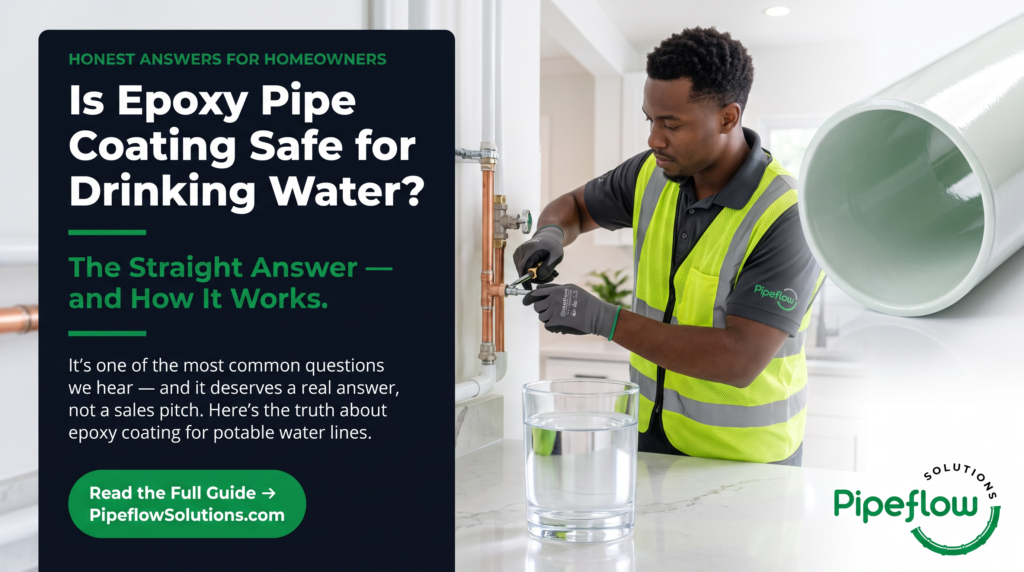
If you’ve been researching options for aging or corroding water supply pipes, you’ve probably come across epoxy pipe coating — a method of rehabilitating pipes from the inside by applying a protective epoxy barrier to the interior walls, rather than tearing them out and replacing them. And if you’re like most homeowners looking into it, your first two questions are the right ones: is it safe to have epoxy coating the pipes that carry my drinking water, and does it actually work, or is it a shortcut that fails down the road?
These are fair and important questions, and they deserve straight answers. The short version: epoxy coating for potable water lines, when done with the right materials by a qualified contractor, is a proven and safe rehabilitation method — the coating materials used for drinking water applications are specifically formulated and certified for potable water contact. But the qualifiers in that sentence matter enormously, and understanding them is what lets you make an informed decision rather than a nervous one. This article walks through how the method works, what makes it safe, where it’s appropriate, and what to verify before you agree to it.
How Epoxy Pipe Coating Works
Epoxy pipe coating rehabilitates an existing water supply pipe by lining its interior with a protective epoxy barrier. Unlike CIPP lining used in sewer applications — which installs a resin-saturated liner that forms a structural pipe within the pipe — epoxy coating for water supply lines typically applies the epoxy directly to the cleaned interior surface of the existing pipe, creating a barrier coating that seals the pipe wall, stops corrosion, and prevents the metal of the host pipe from contacting the water flowing through it.
The process begins with a thorough assessment and cleaning of the existing lines. The pipes are cleaned internally — removing corrosion, scale, and buildup — to expose a clean surface for the epoxy to bond to. This cleaning step is critical; the coating can only be as good as the surface it’s applied to. Once the pipes are clean and dry, the epoxy is applied to coat the interior walls, either by drawing the epoxy through the line or by an application method appropriate to the pipe configuration. The epoxy is then cured, hardening into a smooth, durable barrier bonded to the interior of the pipe.
The result is an existing pipe with a new protective interior surface — one that isolates the water from the corroding metal, seals small leaks and pinholes, smooths the interior to improve flow, and extends the service life of the pipe system substantially without the pipes ever being removed from the walls. For homeowners, that means the corrosion and water quality problems that come from aging metal pipes can be addressed without the demolition, wall opening, and reconstruction that full repiping requires.
The Safety Question, Answered Directly
The safety concern is the first thing on most homeowners’ minds, and it’s worth addressing head-on rather than dancing around it: yes, epoxy coating designed for potable water is safe when the correct certified materials are used and the application is done properly. But that answer comes with conditions that a responsible contractor takes seriously and that you have every right to verify.
The key to safety is the epoxy material itself. Epoxy coatings intended for drinking water contact are formulated specifically for potable water applications and are certified to standards that govern what materials may safely contact drinking water. The relevant certification to look for is NSF/ANSI Standard 61, which is the American national standard that establishes health-effects requirements for materials and products that contact drinking water. A coating certified to NSF/ANSI 61 has been tested and verified not to leach harmful contaminants into the water at levels of concern. When a contractor uses NSF/ANSI 61-certified epoxy for a potable water line, they’re using material that has been specifically evaluated and approved for exactly this purpose.
This is why the material question isn’t a detail — it’s the whole safety question. Not all epoxy is potable-water certified, and using an industrial or general-purpose epoxy on a drinking water line would be inappropriate. A qualified contractor uses only certified potable water coating materials for water supply applications, and provides documentation of that certification. This is a reasonable thing to ask for, and any contractor doing this work correctly will be able to show you the material specifications and certification without hesitation. If a contractor can’t or won’t confirm the coating material is NSF/ANSI 61 certified for potable water, that’s the signal to stop and reconsider.
Proper curing is the second safety factor. Epoxy needs to cure fully and correctly to be stable and inert. A properly cured potable-water epoxy coating is chemically stable and doesn’t release material into the water. This is a function of correct application by a contractor who follows the material manufacturer’s specifications — another reason the qualification and experience of the contractor performing the work matters as much as the material they’re using.
Does It Actually Work? Where Epoxy Coating Is the Right Solution
Setting safety aside, the practical question is whether epoxy coating delivers a durable, effective result — and the honest answer is that it works well for the situations it’s designed for, and isn’t the right answer for situations it’s not designed for. Knowing the difference is what separates an appropriate application from a disappointing one.
Epoxy coating is well-suited to water supply pipes that are corroding internally but still have structural integrity — pipes where the walls are intact enough to serve as a sound substrate for the coating, but where interior corrosion is degrading water quality, causing discoloration, promoting pinhole leaks, or restricting flow through scale buildup. This describes a great many aging copper and galvanized systems that haven’t yet failed structurally but are clearly deteriorating. For these pipes, coating stops the corrosion process, seals developing leak points, improves water quality by isolating the water from the corroded metal, and extends the system’s service life — all without the disruption of repiping.
The method is particularly valuable in situations where full repiping would be exceptionally disruptive or difficult. Pipes running through finished walls, concrete, or hard-to-access locations, historic properties where preserving the structure matters, and occupied buildings where extended demolition and reconstruction is impractical are all scenarios where in-place epoxy coating offers a meaningful advantage over tearing the system out. The ability to rehabilitate the pipes without opening walls and ceilings is the core of the value proposition.
Where epoxy coating is not the right answer is on pipes that have deteriorated past the point of structural soundness. A pipe with severe wall loss, extensive pitting through the pipe wall, or actual structural failure doesn’t have the sound substrate that coating requires — there’s not enough intact pipe left for the coating to protect and reinforce. A pipe in that condition needs replacement, not coating. This is the same principle that governs sewer lining: the rehabilitation method requires a structurally present pipe to work with, and when the pipe is too far gone, replacement is the correct path. An honest assessment of the pipe’s actual condition is what determines which category a given system falls into.
Epoxy Coating vs. Repiping: Making the Comparison Honestly
For a homeowner deciding between epoxy coating and full repiping of their water supply lines, the comparison comes down to the condition of the existing pipes, the disruption tolerance of the situation, and the long-term goals for the property. Both are legitimate solutions; they’re suited to different circumstances.
Repiping — removing the old pipes and installing new ones — is the more definitive solution and the necessary one when pipes have deteriorated past the point of rehabilitation. It gives you an entirely new pipe system with a full service life ahead of it, and for pipes at or near structural failure, it’s the only real option. The trade-off is disruption and cost: repiping means opening walls and ceilings to access and replace the pipes, followed by drywall repair and finish restoration, and it’s a more involved and expensive project as a result.
Epoxy coating is the less disruptive and often less expensive solution for pipes that are corroding but still structurally sound. It rehabilitates the existing system in place, avoiding the demolition and reconstruction that repiping requires, and it can often be completed with far less disturbance to the home. The trade-off is that it’s a rehabilitation of existing pipe rather than a full replacement — appropriate and durable for the right pipe condition, but dependent on the existing pipe having enough remaining integrity to serve as a sound foundation for the coating.
The decision between them isn’t a matter of one being universally better. It’s a matter of matching the method to the pipe’s actual condition, which is why a proper assessment — ideally including inspection of the pipe interior to evaluate the extent of corrosion and remaining wall integrity — should precede the decision. A contractor who recommends one approach or the other without assessing the actual condition of your pipes is guessing, and a decision of this consequence shouldn’t rest on a guess.
What to Verify Before You Agree to Epoxy Coating
Because the safety and effectiveness of epoxy coating both depend heavily on materials and workmanship, there are specific things a homeowner should confirm before proceeding — and a qualified contractor will welcome these questions rather than deflecting them.
- Confirm the coating material is certified to NSF/ANSI Standard 61 for potable water contact, and ask to see the material documentation. This is the single most important verification for a drinking water application.
- Confirm the contractor is licensed and experienced specifically with potable water pipe coating — this is specialized work, and general plumbing experience isn’t the same as demonstrated experience with this particular method.
- Ask about the assessment process and insist that the condition of your pipes is evaluated before a recommendation is made, so you know the coating is appropriate for your specific system rather than being applied on the assumption that it’s suitable.
- Ask about warranty — what’s covered, for how long, and what the process is if there’s an issue with the coating after application.
These verifications aren’t adversarial. They’re the reasonable due diligence that any consequential home infrastructure decision warrants, and a reputable contractor doing this work correctly has clear, confident answers to all of them.
People Also Ask
Is epoxy pipe lining safe for drinking water?
Yes, when the correct materials are used and the application is done properly. Epoxy coatings intended for potable water are formulated specifically for drinking water contact and certified to NSF/ANSI Standard 61, which establishes health-effects requirements for materials that contact drinking water. A coating certified to this standard has been tested and verified not to leach harmful contaminants into the water. The safety depends on using certified potable-water epoxy — not general-purpose or industrial epoxy — and on proper application and full curing by a qualified contractor.
What is NSF/ANSI 61 certification for pipe coating?
NSF/ANSI Standard 61 is the American national standard that sets health-effects requirements for materials and products that contact drinking water, including pipe coatings. A coating certified to NSF/ANSI 61 has been independently tested to confirm it does not release contaminants into drinking water at levels of health concern. For any epoxy coating applied to a potable water line, NSF/ANSI 61 certification is the key credential to verify — it’s what confirms the material is approved for safe contact with drinking water.
Does epoxy pipe coating actually work?
For the right pipe condition, yes. Epoxy coating is effective for water supply pipes that are corroding internally but remain structurally sound — it stops corrosion, seals pinhole leaks, isolates the water from the deteriorated metal to improve water quality, and extends the pipe’s service life, all without replacement. It is not appropriate for pipes that have deteriorated past structural soundness, which need replacement rather than coating. The effectiveness depends on matching the method to the pipe’s actual condition, which is why an assessment should precede the decision.
Is epoxy coating cheaper than repiping?
In many cases, yes — epoxy coating rehabilitates existing pipes in place, avoiding the wall demolition, pipe removal, and reconstruction that full repiping requires, which typically makes it less disruptive and less expensive. However, it’s only an option for pipes that are structurally sound enough to serve as a foundation for the coating. Pipes that have deteriorated past that point require repiping, in which case coating isn’t a viable lower-cost alternative. The right comparison depends on the actual condition of the pipes.
How long does epoxy pipe coating last?
A properly applied potable-water epoxy coating on a structurally sound pipe is designed to add decades of service life to the pipe system. The exact longevity depends on the condition of the host pipe, the quality of the surface preparation and application, and the water conditions the system carries. As with any pipe rehabilitation method, the durability of the result depends significantly on the pipe being an appropriate candidate and the work being performed correctly by a qualified contractor.
What’s the difference between epoxy coating and CIPP lining for water pipes?
Epoxy coating applies a protective epoxy barrier directly to the cleaned interior of an existing pipe, sealing the surface and stopping corrosion. CIPP (cured-in-place pipe) lining installs a resin-saturated liner that cures into a structural pipe within the host pipe. CIPP is used predominantly for sewer and drain applications, while epoxy barrier coating is commonly used for water supply line rehabilitation. Both rehabilitate pipes from the inside without excavation; the appropriate method depends on the application, the pipe type, and the pipe’s condition — which a qualified contractor determines through assessment.
The Bottom Line
Epoxy pipe coating for water supply lines is a legitimate, proven rehabilitation method — not a shortcut, and not something to be nervous about, provided the work is done correctly with the right materials. The safety question has a clear answer: potable-water epoxy certified to NSF/ANSI Standard 61 is specifically formulated and tested for drinking water contact, and when a qualified contractor uses certified material and applies it properly, coating your water lines is safe. The effectiveness question has an equally clear answer, with a condition attached: it works well for pipes that are corroding but structurally sound, and isn’t appropriate for pipes that have deteriorated past the point of rehabilitation.
What ties both answers together is the same theme that runs through every consequential pipe decision — the outcome depends on an honest assessment of your pipe’s actual condition and qualified work using the right materials. That’s what separates a good result from a disappointing one, and it’s why the assessment comes first. Pipeflow Solutions provides water supply pipe rehabilitation and works from an evaluation of your pipes’ actual condition before recommending coating, repiping, or another approach — so the method matches your system rather than being applied on assumption. To have your water supply lines assessed or to discuss whether epoxy coating is right for your situation, call 855-858-1619 or visit pipeflowsolutions.com.