
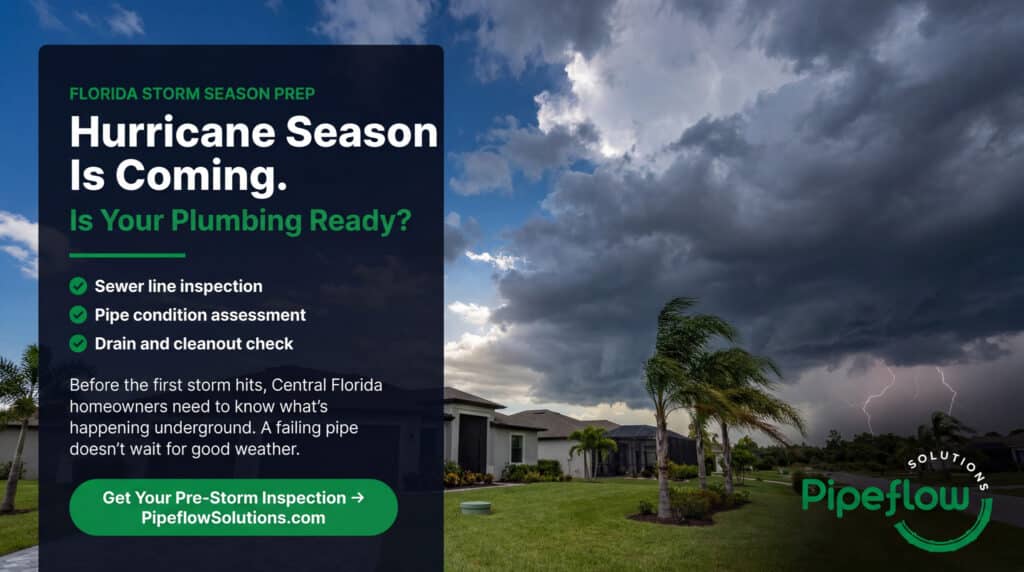
Most Florida homeowners have a storm prep routine. They know when to buy plywood, when to fill the bathtub, and when to charge the portable generator. What rarely makes the checklist is the plumbing system — specifically, the underground infrastructure that handles everything your home drains and flushes during and after a storm event. That gap tends to stay invisible right up until the moment a flooded yard, a backed-up sewer, or a broken pipe turns a manageable storm situation into an expensive one.
The case for plumbing inspection before hurricane season isn’t about preparing for a catastrophic direct hit. It’s about recognizing that even a typical Florida rainy season storm — the kind that drops five inches in two hours and moves on — creates specific stresses on plumbing systems, and that those stresses fall hardest on pipes that were already compromised. A sewer lateral with hairline cracks that was draining fine in April will respond very differently to ground that’s fully saturated in August. A stormwater drain that cleared slowly last fall becomes a flood pathway when the next tropical system rolls through. Getting ahead of these vulnerabilities before storm season starts is the kind of maintenance decision that’s easy to defer and genuinely costly to regret.
Why Hurricanes and Tropical Storms Are Uniquely Hard on Plumbing
Florida’s geography creates a set of conditions during storm events that test plumbing systems in ways that don’t exist in most other parts of the country. Understanding what’s actually happening underground during a major rain event explains why pre-season inspection matters more here than almost anywhere else.
When the ground becomes fully saturated — which happens quickly in Central Florida’s sandy, low-permeability soils during heavy rainfall — the hydrostatic pressure surrounding underground pipes increases significantly. Any crack, failed joint, or point of structural weakness in a sewer lateral becomes an entry point for groundwater. This phenomenon, called inflow and infiltration, floods the pipe with stormwater that the pipe was never designed to carry. When your sewer lateral is already handling normal household wastewater and suddenly taking on large volumes of infiltrating groundwater through every crack in the pipe wall, the system backs up — not because anything new broke, but because the existing weaknesses couldn’t handle the additional load.
The same dynamic affects municipal lift stations — the pumping stations that move sewage from residential sewer systems to treatment facilities. During major storm events, lift stations across Central Florida get overwhelmed by infiltration across their entire service area simultaneously. When a lift station can’t keep up with inflow, the system backs up from the municipal side, and the backup travels up through the path of least resistance — which is often a residential lateral connected to a compromised sewer main. This is why sewage backups happen during storms even in homes whose own plumbing was functioning normally beforehand.
Sandy soils also become destabilized when saturated. Pipes that have been resting on stable ground for decades can shift when that ground loses its load-bearing capacity under flooding. In Florida, where sinkholes are an endemic feature of the geology and are most commonly triggered by ground saturation and soil erosion, a storm event is precisely the scenario that can accelerate the progression from a slow underground leak — which has been eroding the soil column around and beneath a pipe for months or years — to a visible surface problem. Pre-season inspection that catches a leaking lateral before storm season is also, in this sense, sinkhole prevention.
What to Inspect Before the Season Starts
The most important pre-season plumbing inspection step for most Central Florida homeowners is a video camera inspection of the sewer lateral. This is the underground pipe most vulnerable to the conditions described above, it’s the one most homeowners have never thought about, and it’s the one whose failure during a storm event produces the most immediate and unpleasant consequences inside the home. A CCTV inspection run through the lateral from the cleanout will show you exactly where cracks, root intrusions, joint failures, or deterioration exist — and whether those vulnerabilities are likely to be exposed by storm conditions.
Beyond the lateral itself, there are a handful of inspection points that a prepared Central Florida homeowner should address before June 1.
Your sewer cleanout location matters more than most people realize during and after a storm. The cleanout — the capped access pipe near your home’s foundation — is the pressure relief valve for your lateral. A technician responding to a storm-related backup can use it to clear the line without accessing the pipe through a fixture inside the home. Knowing where it is, making sure the cap is seated and accessible, and clearing any vegetation or debris that has grown up around it is a five-minute task that can save significant time in an emergency.
Outdoor drain systems — area drains, yard drains, driveway drains — should be cleared of debris and confirmed to be flowing freely before storm season. These systems are designed to route surface water away from the home and toward stormwater infrastructure. When they’re blocked by leaf matter, sediment, or root growth, that water finds another path, typically toward the foundation. Cleaning them out annually before the rainy season is straightforward maintenance that pays dividends in reduced water intrusion risk.
For homes with sump pumps — more common in newer construction and homes with below-grade spaces — testing the pump before storm season is essential. A pump that hasn’t been run in months may not be operational when it’s needed most. Pour water into the sump pit to confirm the float switch activates the pump and that water is discharging correctly. If the pump hasn’t been serviced in several years, having it inspected before the season starts is time well spent.
Water supply shutoffs are worth locating and confirming they operate freely. In the event of a significant pipe break during or after a storm, knowing where your main shutoff is and being able to operate it quickly limits water damage from a rupture. Shutoffs that haven’t been turned in years sometimes seize or fail to close fully — confirming they work before you need them in an emergency is the kind of low-effort, high-value preparation that often gets overlooked.
Finally, if your home has a backflow preventer on the sewer lateral — a device that allows waste to flow toward the main but prevents it from flowing back toward the house during a sewer system backup — confirming it’s in working order before storm season is a genuine line of defense against sewage entering the home during a municipal backup event. Not all homes have these installed, and they’re not a substitute for addressing a deteriorating lateral, but a functioning backflow preventer is a meaningful safeguard during major storm system overloads.
What to Do During and After a Storm
During an active storm event with heavy rainfall, the single most effective thing you can do to reduce backup risk is minimize water use inside the home. Every flush, every shower, every dishwasher cycle adds volume to a sewer system that may already be operating near capacity due to infiltration. This is particularly true during and immediately after the heaviest rainfall, when municipal lift stations are under maximum stress. If a Tropical Storm or Hurricane Warning is in effect for your area, treating your plumbing use as you would during an advisory — conserving, not adding load — is a practical step that costs nothing.
After a storm passes and flooding recedes, a visual inspection of your yard and the path where your sewer lateral runs to the street is worth doing before assuming everything is fine underground. Soft spots, depressions, or areas where the soil has settled unevenly along the lateral path can indicate soil erosion around the pipe — a condition that warrants a camera inspection before it progresses further. Any cracking in concrete or pavers above the lateral path following a significant storm is similarly worth flagging.
If you experience a backup during or shortly after a storm event, the response is the same as any sewer emergency: stop water use, avoid the affected area until it can be assessed, and contact a licensed sewer repair company. The cause may be a municipal system issue, a problem with your own lateral, or a combination — the camera inspection is what determines which and points toward the appropriate response.
People Also Ask
How does hurricane season affect plumbing in Florida?
Heavy rainfall saturates the ground around sewer laterals, increasing the pressure on any existing cracks or failed joints and allowing stormwater to infiltrate the pipe. This can cause backups even in systems that were functioning normally in dry conditions. Storm events also stress municipal lift stations, which can cause backups on the public side that travel into residential systems. Additionally, Florida’s sandy soils become destabilized when saturated, increasing the risk of pipe movement and sinkhole formation around underground leaks.
What plumbing should I inspect before hurricane season in Florida?
The most important inspection is a video camera examination of your sewer lateral to identify cracks, root intrusions, or joint failures that storm-season ground saturation would stress. Beyond that:
- Confirm your sewer cleanout is accessible and capped
- Clear outdoor area drains and yard drains of debris
- Test any sump pump before the rainy season begins
- Confirm main water supply shutoffs operate freely
- Check that any backflow preventer on the lateral is in working order
Can a hurricane cause a sewer backup in my home?
Yes. Heavy rainfall during tropical storms and hurricanes can overwhelm both individual sewer laterals — particularly ones with existing cracks that allow stormwater infiltration — and municipal lift stations that serve entire neighborhoods. When a lift station is overwhelmed, sewage can back up through connected residential laterals. Homes with deteriorating laterals are significantly more vulnerable to both types of backup during storm events.
How do sinkholes and storms relate to plumbing?
Sinkholes in Florida are commonly triggered or accelerated by ground saturation, which removes the soil column supporting the ground surface. An underground pipe that has been leaking slowly — eroding the surrounding soil — represents an existing vulnerability that a major rain event can convert from a manageable maintenance issue to a surface-level failure. Pre-season sewer inspection that catches a leaking lateral before storm season reduces this risk meaningfully.
Is a sewer inspection worth getting before hurricane season?
For any Central Florida home with a lateral over 15 to 20 years old, or with significant tree coverage near the lateral path, yes. A camera inspection before storm season tells you whether existing vulnerabilities in your lateral are likely to be exposed by the conditions a major rain event creates. Addressing a cracked or root-intruded lateral with trenchless lining before it fails under storm load is substantially less expensive and less disruptive than responding to a backup during or after a storm.
What should I do if my sewer backs up during a hurricane?
- Stop all water use in the home immediately
- Keep everyone away from the affected area — sewage is a biohazard
- Open windows to ventilate if sewer gas is present
- Document the backup with photos and video before any cleanup
- Once conditions are safe, contact a licensed sewer repair company to assess whether the cause is a municipal system issue, a problem with your own lateral, or a combination of both
The Bottom Line
Hurricane preparedness in Florida tends to focus on the visible and the dramatic — the roof, the windows, the evacuation plan. The plumbing system, running silently underground, rarely makes the list until it fails at the worst possible moment. The conditions that Florida storm season creates — saturated soil, infiltrating groundwater, overwhelmed municipal infrastructure — fall hardest on laterals that were already compromised, and Central Florida has an enormous inventory of aging clay and cast iron laterals that fit that description exactly.
A pre-season video inspection isn’t a significant investment of time or money relative to what it tells you. If the lateral is in good shape, you have genuine peace of mind heading into storm season. If it shows vulnerabilities that warrant attention, addressing them before the rains arrive is less expensive, less disruptive, and less stressful than responding to a failure in the middle of a storm event. Pipeflow Solutions offers free video inspections as the starting point — a straightforward look at what’s actually in your pipes before the season that will test them most severely arrives.