
When a sewer problem surfaces — a backup, a collapsed pipe, a repair quote that arrives with a number you weren’t expecting — one of the first questions homeowners ask is whether the city is responsible for fixing it. It’s a reasonable question, and the answer depends entirely on where the damage is located within a system that most people have never thought about in any detail.
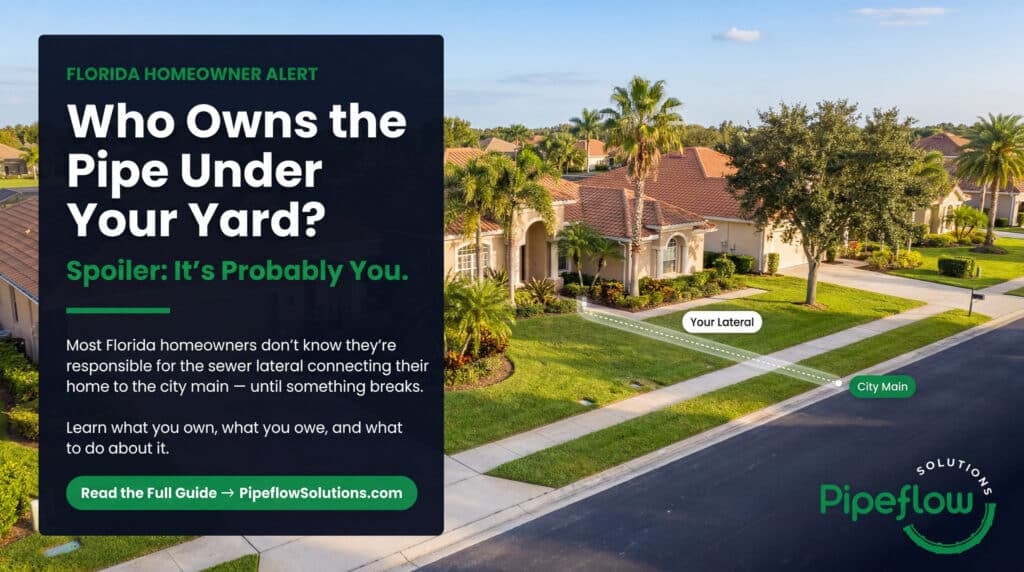
The short answer is this: the city owns and maintains the sewer main running beneath the street. You, the homeowner, own and are responsible for the sewer lateral — the pipe that connects your home’s plumbing to that main. Where those two systems meet is where your financial responsibility begins, and for most residential sewer repairs in Central Florida, the damage is squarely on the homeowner’s side of that line.
What a Sewer Lateral Actually Is
The sewer lateral is the underground pipe that carries wastewater from every drain and toilet in your home to the municipal sewer main in the street. It runs from the base of your home’s plumbing system — typically exiting through the foundation or beneath the slab — across your property, under the sidewalk, and connects to the main sewer line running beneath the road.
This pipe is almost entirely invisible during the normal life of a home. It sits two to six feet underground, sometimes deeper, and most homeowners go years or decades without any reason to think about it. The only time it becomes a topic of conversation is when something goes wrong — and by then, the damage has typically been developing for a long time.
In terms of length, a residential sewer lateral is commonly anywhere from 30 to 100 feet depending on how far the home sits from the street. That entire run — from the structure to the point of connection with the municipal main — is the homeowner’s pipe. In most Florida municipalities, the homeowner’s responsibility extends all the way to the connection point at the main, sometimes called the wye or the tap, regardless of whether that connection sits beneath the sidewalk or the street itself.
Where City Responsibility Ends and Yours Begins
The municipal sewer main is owned, operated, and maintained by the city or county utility authority. If the main line beneath the street collapses, becomes severely blocked, or causes a backup that traces to an infrastructure failure on the public side, that’s the city’s problem to diagnose and repair. Utility crews have jurisdiction over the main and the connection hardware at the point where your lateral ties in.
Everything on the property side of that connection — your full lateral from house to main — is your responsibility as the property owner. This is true even if a portion of your lateral runs beneath the public sidewalk or the right-of-way between the sidewalk and the street. The physical location of the pipe does not transfer responsibility to the municipality. What matters is which system the pipe belongs to, and your lateral belongs to you.
This distinction catches homeowners off guard because it feels counterintuitive. If a section of your lateral runs beneath a city sidewalk, the idea that you’re responsible for a pipe you can’t easily access under public infrastructure seems unfair. But it’s the near-universal standard across Florida municipalities, and it’s why trenchless pipe repair methods are so valuable in this context — they allow that lateral to be rehabilitated without tearing up sidewalks, streets, or right-of-way surfaces that would otherwise require permits, coordination with the city, and significant restoration costs.
Why Florida Homeowners Face This Issue More Than They Expect
Central Florida’s housing stock creates a particular concentration of sewer lateral problems for a few compounding reasons. Homes built before 1980 — and there are a great many of them across Orlando, Kissimmee, Sanford, Clermont, and surrounding communities — were commonly plumbed with clay or cast iron sewer laterals. Both materials served reasonably well for their time, but both have finite lifespans and degrade in predictable ways.
Clay laterals crack, lose joint integrity, and allow root intrusion as the soil around them shifts over decades. Florida’s sandy, expansive soils are not stable foundations for rigid pipe, and the slight ground movement that accumulates over 40 or 50 years is enough to separate joints and create entry points for the root systems of the mature oak, magnolia, and camphor trees that are common throughout Central Florida neighborhoods. Cast iron corrodes from the inside out, gradually narrowing the pipe’s interior diameter before eventually pitting through the pipe wall entirely.
Neither of these failure modes announces itself dramatically. They develop slowly, over years, until the system reaches a point where it can no longer handle normal household load — and then a Tuesday morning flush becomes a crisis. By that point, the damage has usually progressed well beyond what it would have cost to address earlier.
What Sewer Lateral Maintenance Actually Looks Like
For most homeowners, sewer lateral maintenance is a completely unfamiliar concept. Unlike HVAC filters or roof inspections, nobody ever tells you that your underground pipe needs periodic attention. But the reality is that proactive maintenance is both possible and cost-effective compared to responding to failures after the fact.
The foundation of any maintenance approach is periodic video camera inspection. A licensed technician runs a CCTV camera through the lateral from the cleanout — the capped access pipe near your home’s foundation — and produces footage that shows exactly what’s happening inside the pipe. The kinds of issues that are visible and diagnosable before they’ve caused a blockage or structural failure include:
- Root intrusion at joints
- Early-stage corrosion
- Minor cracks
- Sediment buildup
- Bellies (low spots where waste accumulates)
For homes over 20 years old, or any home with significant tree coverage near the lateral path, an inspection every two to three years is a reasonable cadence.
When inspection reveals root intrusion or buildup without structural damage, hydro jetting can clear the line and restore full flow capacity. This is a maintenance intervention — it addresses the symptom and buys time — but it doesn’t repair the underlying vulnerability if the roots are entering through cracks or failing joints. For a lateral that’s structurally sound but showing early deterioration, CIPP lining can rehabilitate the full run, seal off root entry points, and extend the pipe’s service life by 50 years or more without any excavation. Addressing a lateral at this stage is categorically less expensive and less disruptive than waiting for a collapse.
What to Do If You’re Not Sure Where Your Lateral Is or What Condition It’s In
Most homeowners don’t know the path of their sewer lateral, where their cleanout is, or how old their lateral pipe is. All of that is knowable, and finding it out costs much less than you’d expect relative to the peace of mind it provides.
Your home’s original building permits and plumbing plans, if available through the county property appraiser or building department, will show the lateral routing. Alternatively, a video inspection with a locator — standard equipment for licensed sewer contractors — can map the pipe path as the camera travels through it, giving you a clear picture of where the lateral runs and what it looks like internally. For homes in Central Florida built before 1980, that inspection will often reveal exactly the kind of early-stage deterioration that’s much easier to address now than after a failure.
The cleanout — your access point to the lateral for inspections and cleaning — is typically a white or black PVC cap, three to four inches in diameter, located outside the home near the foundation. Some older homes have cleanouts inside, near a bathroom or utility area. If you don’t know where yours is, finding it before you need it is a useful ten-minute exercise.
People Also Ask
Who is responsible for the sewer lateral — the homeowner or the city?
The homeowner is responsible for the sewer lateral from the home to the point of connection with the municipal sewer main. The city or county utility authority is responsible for the main line itself. In most Florida municipalities, this means the homeowner owns the entire lateral — including any portion that runs beneath a public sidewalk or right-of-way — up to the connection point at the main.
What is the difference between a sewer lateral and a sewer main?
The sewer main is the large-diameter pipe running beneath the street that collects wastewater from the entire neighborhood and routes it toward treatment facilities. It is owned and maintained by the municipal utility. The sewer lateral is the smaller pipe connecting an individual property to the main — it is owned by and is the financial responsibility of the property owner.
Does homeowners insurance cover sewer lateral repair?
Standard homeowners insurance policies typically do not cover sewer lateral repair or replacement. Some insurers offer sewer backup coverage as an endorsement that can be added to a policy, which may cover damage caused by a backup but not necessarily the repair of the failed pipe itself. Reviewing your policy and speaking with your insurance agent about sewer lateral coverage is worthwhile, particularly for owners of older homes.
How do I know if my sewer lateral is failing?
Common warning signs of a failing sewer lateral include:
- Multiple slow drains occurring simultaneously
- Sewage odors in the yard or inside the home
- Recurring drain backups that return after clearing
- Wet or unusually green patches in the yard above the lateral path
- Gurgling sounds from toilets or floor drains
A video camera inspection is the only reliable way to confirm the condition of the pipe regardless of whether symptoms are present.
How long do sewer laterals last in Florida?
Clay sewer laterals commonly used in homes built before the 1970s have a general lifespan of 50 to 100 years, but Florida’s soil conditions and root systems frequently shorten that range in practice. Cast iron laterals typically last 50 to 75 years before corrosion compromises their integrity. In both cases, condition varies significantly based on soil movement, tree coverage, and maintenance history — the pipe’s age is a starting point for concern, not a definitive indicator of its current state.
What is a sewer cleanout and why does it matter?
A sewer cleanout is a capped access pipe that provides direct entry to the sewer lateral for inspection, cleaning, and diagnostic work. It’s typically located outside the home near the foundation. Knowing where your cleanout is matters because it’s the point through which a camera inspection or hydro jetting equipment is introduced to the line — and in an emergency, it’s how a technician can relieve pressure in a blocked lateral without accessing the pipe through a fixture inside the home.
The Bottom Line
The sewer lateral is one of the most consequential and least visible systems on your property. It handles every drop of wastewater your household produces, it sits underground where it can deteriorate for years without showing obvious symptoms, and when it fails, the repair bill lands entirely on you — not the city, not your utility, and in most cases not your standard homeowners insurance policy.
Understanding that the lateral is your responsibility is the first step. The second is knowing what condition it’s actually in. For homeowners in Central Florida with homes built before 1980, or with significant tree canopy near the sewer line path, a video camera inspection is the most straightforward way to move from uncertainty to a clear picture of where things stand. Pipeflow Solutions offers free video inspections as the starting point — not a sales call, but an honest look at what’s happening inside the pipe so you can make informed decisions about what, if anything, needs to be done.