
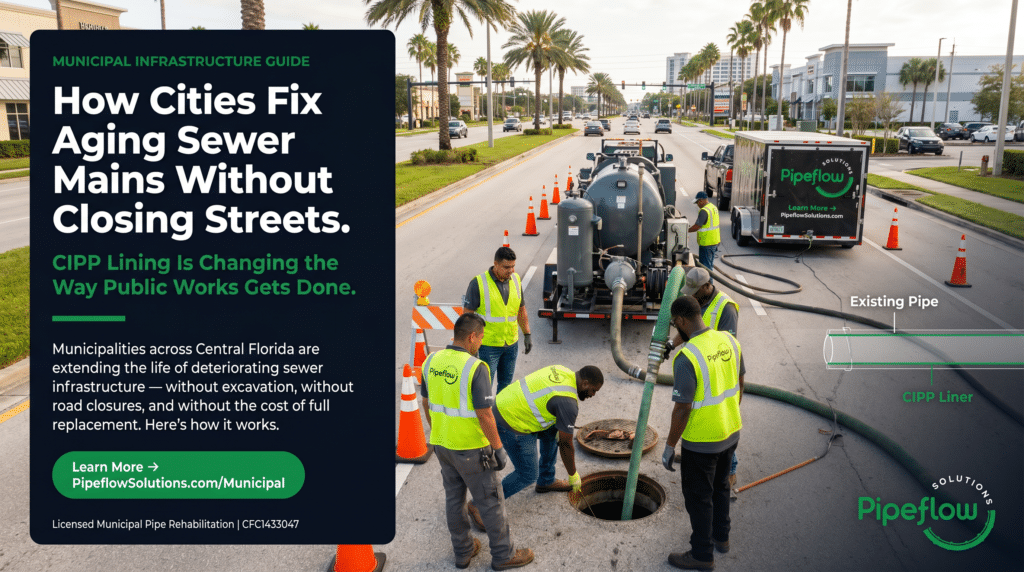
For public works directors and city engineers across Central Florida, the underground infrastructure problem is a familiar one: a significant portion of the sewer system was installed decades ago, it’s approaching or past its designed service life, and the traditional approach to fixing it — excavating streets, closing lanes, and disrupting entire corridors for weeks at a time — carries costs that go far beyond the line item on the repair contract. Municipal sewer rehabilitation through trenchless methods offers a fundamentally different path: restoring aging pipe infrastructure to like-new structural condition from the inside, without opening the road above it.
The technology isn’t new, and for municipal decision-makers, that maturity matters. Trenchless rehabilitation methods have been used on public infrastructure for decades, they’re governed by established ASTM standards, and their performance over time is well-documented. What’s changed is the pressure on municipal budgets and the increasing political and practical cost of extended road closures — both of which have made trenchless rehabilitation not just a technical option but often the more defensible fiscal and operational decision.
The Core Problem: Aging Infrastructure Under Active Roadways
Central Florida’s municipal sewer systems reflect the region’s development history. Infrastructure installed during the growth waves of the mid-20th century through the 1980s is now well into its later years, and the materials used — vitrified clay, cast iron, concrete, and in some cases early-generation PVC — deteriorate along predictable trajectories. Joint failures allow root intrusion and groundwater infiltration. Corrosion degrades pipe walls, particularly in the crown of sanitary sewers where hydrogen sulfide gas generates sulfuric acid. Ground movement in Florida’s sandy soils causes joint separation, offset, and sagging.
The complication that makes municipal sewer rehabilitation distinct from residential work is location. Municipal sewer mains run beneath streets, intersections, sidewalks, and public rights-of-way — beneath exactly the surfaces that a community depends on for daily function. Traditional open-cut replacement of a deteriorating sewer main means excavating the roadway, which triggers a cascade of costs and disruptions: traffic detours, lane closures, business access impacts, utility conflicts with other buried infrastructure, extended construction timelines, and the substantial expense of restoring the road surface, base, and markings afterward. On a busy corridor, the surface restoration and traffic management costs alone can rival or exceed the cost of the pipe work.
Trenchless rehabilitation removes the roadway from the equation almost entirely. The pipe is rehabilitated through existing manholes and access points, the traffic impact is minimal and short-duration, and the road surface is never opened. For a public works team weighing how to allocate a finite capital budget across a large inventory of aging pipe, that difference reshapes what’s actually achievable within a given funding cycle.
How Trenchless Municipal Rehabilitation Works
The predominant method for municipal sewer main rehabilitation is cured-in-place pipe (CIPP) lining, the same fundamental technology used in residential trenchless repair, scaled and specified for municipal infrastructure. The process rehabilitates the existing pipe from the inside, creating a new structural pipe within the host pipe without excavation.
The sequence begins with inspection and cleaning. A CCTV camera survey documents the existing condition of the pipe segment — the type and extent of deterioration, the location of service connections, and any obstructions that must be addressed before lining. The pipe is then cleaned, typically with high-pressure hydro jetting, to remove roots, debris, grease, and scale, providing a clean surface for the liner to bond to. For municipal work, this pre-lining inspection footage becomes part of the project documentation that engineering and compliance teams require.
A resin-saturated liner is then installed into the host pipe — through an existing manhole, requiring no excavation — and positioned along the full length of the segment being rehabilitated. The liner is inflated against the interior walls of the host pipe and cured, hardening into a structural pipe. Curing methods for municipal work commonly use hot water or steam for larger diameter mains, or UV light curing, which has become increasingly common for its speed and consistency. Once cured, the liner forms a jointless, corrosion-resistant, structurally sound pipe within the old one — sealing off infiltration points, eliminating root intrusion pathways, and restoring flow capacity.
Service connections are then reinstated. Because the liner seals over the lateral connections along the rehabilitated main, those connections are reopened robotically from inside the pipe, restoring service to connected properties without excavation. A final CCTV survey documents the completed installation, confirming the liner is properly seated, fully cured, and free of defects — and providing the post-work verification that municipal engineers and asset managers require for their records.
The entire process for a given pipe segment is typically completed in a fraction of the time an open-cut replacement of the same segment would require, and without the road ever being opened.
The Fiscal Case for Trenchless Rehabilitation
For municipal decision-makers, the case for trenchless rehabilitation rests on total cost of ownership rather than the unit cost of the pipe work alone — and it’s on total cost that trenchless methods make their strongest showing.
The direct construction cost comparison between trenchless rehabilitation and open-cut replacement varies by pipe diameter, depth, and site conditions, and on a pure per-linear-foot basis for the pipe work itself, the two methods can be closer than expected. But the pipe work is only part of the municipal cost picture. Open-cut replacement carries substantial ancillary costs that trenchless methods largely eliminate:
- Traffic management and maintenance-of-traffic plans
- Roadway restoration including base and surface
- Sidewalk and curb restoration
- Utility relocation or protection where the excavation conflicts with other buried infrastructure
- Extended labor and equipment costs of a longer construction timeline
When these are included, trenchless rehabilitation frequently delivers meaningful savings on total project cost.
There’s also the matter of indirect and social costs, which municipal decision-makers increasingly account for even when they don’t appear on the construction invoice. Extended road closures impose real costs on the community — lost business revenue in affected commercial corridors, increased travel times and fuel costs for residents and commuters, emergency vehicle access complications, and the political cost of prolonged disruption. Trenchless rehabilitation’s minimal surface footprint and short duration reduce these indirect costs dramatically, which is a significant part of why the method has become the preferred approach for infrastructure work in populated corridors.
Finally, there’s the service life consideration. A properly installed CIPP liner is engineered for a 50-year design life, comparable to new pipe. Municipalities are not trading a shorter-lived repair for lower disruption — they’re getting a rehabilitation that resets the asset’s service life clock while avoiding the excavation entirely. For capital planning purposes, that combination of long service life and low disruption is what makes trenchless rehabilitation a sound long-term infrastructure investment rather than a stopgap.
What Public Works Teams Should Expect From a Qualified Contractor
Municipal sewer rehabilitation is not a service to award on price alone, and experienced public works teams evaluate trenchless contractors against a set of criteria specific to the demands of public infrastructure work.
Licensing and qualifications are the starting point. For underground utility infrastructure work, a contractor should hold the appropriate underground utility and excavation contractor licensing in addition to plumbing credentials — in Florida, that means a CUC license alongside the plumbing contractor license. Pipeflow Solutions holds both Certified Plumbing Contractor license CFC1433047 and Underground Utility and Excavation Contractor license CUC1226111, the credential combination relevant to municipal infrastructure work. Beyond licensing, industry certifications such as NASSCO training indicate the crews performing the work have been evaluated against established standards for pipe inspection, cleaning, and rehabilitation.
Materials compliance is non-negotiable for municipal work. The liners, resins, and coatings used must meet applicable ASTM standards and local code requirements, and a qualified contractor provides documentation confirming this. Public works teams should expect material specifications and compliance certifications as a standard part of the project documentation, not something that has to be requested after the fact.
Documentation and reporting capability is where municipal work differs most from residential. Cities need pre- and post-rehabilitation CCTV footage, digital condition assessments, GIS-compatible location and asset data, and reporting formatted for engineering review and permitting compliance. A contractor experienced in municipal work builds this documentation into the project as a matter of course, because they understand it’s not optional — it’s what the engineering department, the permitting authority, and the asset management system require.
Familiarity with municipal procurement is the final piece. Public sector work operates through open bids, RFPs, pre-qualified vendor lists, and formal procurement processes that differ substantially from residential service. A contractor accustomed to working with municipalities understands these processes, can navigate the bidding and contracting requirements, and can coordinate scheduling around city crews, phased closures, off-hours work windows, and the operational realities of keeping public infrastructure in service during rehabilitation.
Coordinating Rehabilitation Around a Functioning City
One of the practical advantages of trenchless rehabilitation for municipal clients is scheduling flexibility, which experienced contractors use to minimize impact on the community and coordinate with the city’s own operations. Because the surface footprint is small and the work happens through existing access points, rehabilitation can often be scheduled during off-peak hours, overnight, on weekends, or in phased windows that keep corridors functional during high-traffic periods.
This flexibility matters for public works teams managing rehabilitation across an active city. Coordinating with existing city crews, timing work to avoid conflict with events or peak commercial periods, and sequencing rehabilitation across a system in a way that maintains service continuity are all part of executing municipal infrastructure work well. A contractor who understands municipal operations approaches the schedule as a collaboration with the city’s team rather than imposing a fixed construction timeline on a community that has to keep functioning around it.
For emergency situations — a sudden main failure, a sinkhole, a backup beneath a critical corridor — the rapid-response capability of a trenchless contractor familiar with the local system is a genuine asset. The same methods that rehabilitate infrastructure on a planned schedule can be deployed to address urgent failures with far less disruption and faster restoration of service than emergency excavation would allow.
People Also Ask
How do municipalities repair sewer lines without closing roads?
Cities use trenchless rehabilitation methods — primarily cured-in-place pipe (CIPP) lining — to restore aging sewer mains from the inside without excavating the roadway. A resin-saturated liner is installed through existing manholes, inflated against the host pipe, and cured into a new structural pipe within the old one. Because the work happens through existing access points, the road surface is never opened, traffic disruption is minimal, and the rehabilitated pipe achieves a service life comparable to new pipe.
What is CIPP lining for municipal sewers?
CIPP (cured-in-place pipe) lining is a trenchless rehabilitation method in which a resin-saturated liner is installed inside an existing sewer main and cured to form a new jointless pipe within the host pipe. For municipal infrastructure, it seals infiltration points, eliminates root intrusion, restores flow capacity, and provides a corrosion-resistant interior — all without excavation. It’s governed by established ASTM standards and is engineered for a 50-year design life.
Is trenchless rehabilitation cheaper than replacing a sewer main?
On the pipe work alone, the two methods can be comparable, but when the full cost of open-cut replacement is included — traffic management, roadway restoration, utility conflicts, extended timelines, and the indirect costs of prolonged road closure — trenchless rehabilitation frequently delivers significant total-cost savings. For municipal infrastructure beneath active roadways, the elimination of surface restoration and traffic disruption is where the majority of the savings is realized.
How long does a CIPP liner last in a municipal sewer?
A properly installed CIPP liner is engineered for a 50-year design life, comparable to a newly installed pipe. Rather than a temporary fix, trenchless rehabilitation resets the asset’s service life while avoiding excavation, which is what makes it a sound long-term infrastructure investment for capital planning purposes.
What licensing should a municipal sewer rehabilitation contractor hold in Florida?
For municipal underground utility infrastructure work in Florida, a contractor should hold an Underground Utility and Excavation Contractor (CUC) license in addition to a Certified Plumbing Contractor (CFC) license. Industry certifications such as NASSCO training further indicate the crews are qualified against established standards for inspection, cleaning, and rehabilitation. Materials should meet applicable ASTM standards, and the contractor should provide compliance documentation as part of standard project reporting.
Can trenchless methods be used for stormwater and municipal drainage infrastructure?
Yes. CIPP lining and related trenchless rehabilitation methods are applicable to stormwater mains, culverts, and municipal drainage infrastructure in addition to sanitary sewers. The same advantages apply — rehabilitation without excavation, minimal surface disruption, and restored structural integrity — making trenchless methods suitable across the range of municipal underground pipe assets.
The Bottom Line
For Central Florida municipalities managing aging sewer infrastructure against constrained budgets and rising expectations around minimizing community disruption, trenchless rehabilitation has moved from an alternative approach to, in many cases, the default one. It restores deteriorating pipe to like-new structural condition, achieves a service life comparable to full replacement, and does it without opening the roadway — eliminating the traffic disruption, surface restoration costs, and extended timelines that make open-cut replacement so expensive in populated corridors.
The method is mature, standards-governed, and well-suited to the documentation and procurement realities of public sector work. What determines whether a municipal rehabilitation project succeeds is the contractor’s combination of proper licensing, materials compliance, documentation capability, and genuine familiarity with municipal operations and procurement. Pipeflow Solutions partners with public works departments and city managers across Central Florida on exactly this work — bringing the licensing, trenchless expertise, and municipal experience that infrastructure rehabilitation requires. To discuss a municipal sewer rehabilitation project or arrange an infrastructure assessment, call 855-858-1619 or visit pipeflowsolutions.com.