
Fast Track Summary
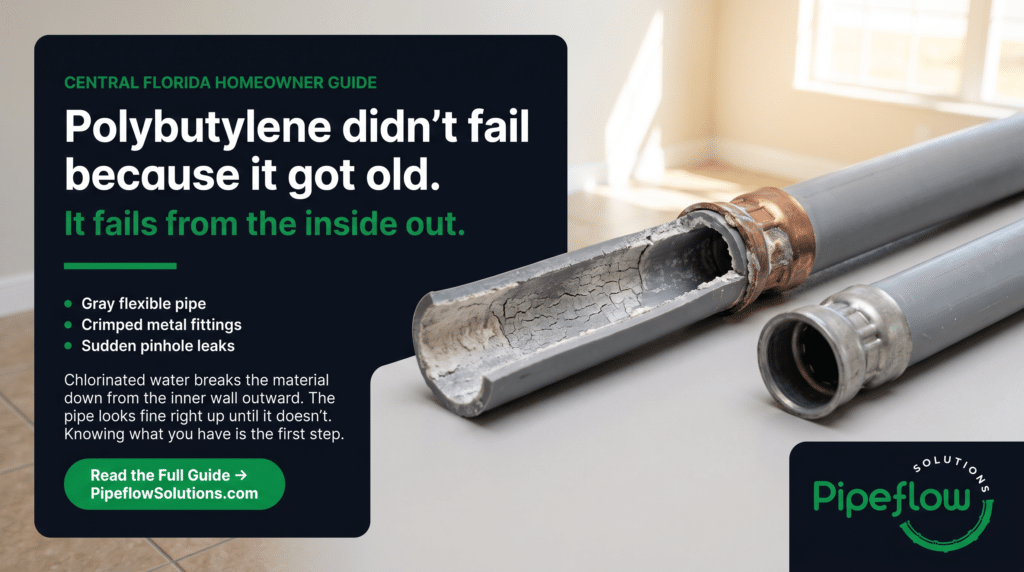
- Why Polybutylene Fails: Chlorine and other oxidants in treated municipal water attack the resin from the inside, making the pipe wall brittle and prone to sudden splits long before the failure is visible from outside.
- Lining Is Not an Option: Polybutylene cannot be rehabilitated with a liner or a spray coating. The host pipe is the problem, so a full repipe of the water supply lines is the only durable fix.
- How to Identify It: Look for flexible gray, blue or black plastic tubing at the water heater, the main shutoff and under sinks, often stamped with a code beginning in PB along with the Quest name on older fittings.
- The Insurance Angle: Florida carriers have grown steadily less willing to write or renew policies on homes with polybutylene supply lines, and many now ask about it directly on the application.
- What Replacement Involves: A whole-home repipe reroutes new supply lines through attic space and walls, opens only the access points required, and finishes with pressure testing, patching and a documented inspection.
A property manager in Winter Park gets the same call twice in one quarter from the same building: a ceiling stain in a second-floor unit, spreading overnight, with no fixture running above it. The maintenance tech cuts an access hole and finds a gray plastic supply line with a hairline split running along its length. The pipe is not corroded and it is not clogged. It simply cracked.
That is the signature of polybutylene, and it is the reason polybutylene pipe replacement keeps landing on budget agendas across Central Florida. This article answers the question homeowners, HOA boards and commercial operators keep asking first: why do polybutylene pipes need to be replaced, rather than repaired, patched or lined? It also covers how to identify the material in your own building, what the insurance market has been doing about it, and what a whole-home repipe actually involves from the first walkthrough to the final pressure test.
Polybutylene was installed widely in Florida homes and multi-family buildings during a stretch when it looked like a cheaper, faster alternative to copper. Much of that pipe is still in service today, still carrying chlorinated municipal water, and still aging in the same direction it has always aged. Understanding that trajectory is the difference between planning a repipe and reacting to a flood.
Why do polybutylene pipes need to be replaced?
Section Overview:
Polybutylene is a flexible plastic water supply pipe installed in many Florida homes and multi-family buildings in the late twentieth century. Oxidants in treated municipal water, chiefly chlorine and chloramine, degrade the resin from the inner wall outward. The pipe becomes brittle, micro-fractures form, and the line splits without warning. Because the damage is inside the pipe wall itself, replacement is the only reliable remedy.
The failure is chemical, not mechanical. Treated water in Central Florida carries disinfectant by design, and that disinfectant is doing exactly what public health requires it to do. Polybutylene resin simply does not tolerate long-term contact with it.
The causal chain, link by link
- Oxidant Contact: Chlorinated or chloraminated municipal water sits against the inner wall of the pipe every hour of every day, including the hours nobody is using water.
- Resin Degradation: The oxidant reacts with the polymer at the inner surface, breaking down the chains that give the material its flexibility.
- Micro-Fracturing: The degraded layer loses elasticity and begins to craze. Tiny fractures form and work outward through the pipe wall, invisible from the exterior.
- Brittleness at the Fittings: Stress concentrates where the pipe is clamped, bent or joined. Older acetal and metal insert fittings amplify that stress, which is why so many failures begin at a connection.
- Sudden Split: Once the fractures reach the outer wall, the pipe releases under normal operating pressure. There is no drip-then-leak warning period the way there often is with corroding metal.
That last link is what makes polybutylene different from cast iron drain lines or aging galvanized supply. A cast iron sewer line usually announces itself gradually through recurring backups, and a camera inspection of the drain line can show you exactly how much wall is left. Polybutylene gives you a normal-looking pipe right up until it does not.
Why lining and coating cannot save it
Trenchless rehabilitation works when the host pipe can still act as a form for a new structural layer. That is the principle behind trenchless pipe repair on drain and sewer lines, and behind spray and brush coating rehabilitation on larger-diameter systems.
Polybutylene supply lines fail both tests. The tubing runs in small diameters through tight bends inside walls and attic framing, with no practical access for lining equipment. More importantly, the material is degrading throughout its wall thickness, so there is no sound host pipe left to build against. Polybutylene cannot be lined. Replacement is the fix. Pipeflow Solutions repipes water supply lines end to end, which is precisely the service this material requires.
How do I know if I have polybutylene pipes in my Florida home?
Section Overview:
Polybutylene is flexible plastic tubing, usually gray, sometimes blue or black, found on water supply lines rather than drains. Check the water heater connections, the main shutoff, the water meter and under sink cabinets. Look for a stamped code beginning with PB, and for older insert fittings carrying the Quest name. Confirmation by a licensed plumber removes any doubt.
Identification is straightforward once you know where to look. Supply lines are the pressurized pipes feeding fixtures, so ignore the larger drain and vent piping entirely.
Where to look, in order
- Water Heater Connections: Start here. The hot and cold lines entering the heater are usually exposed, and the material is easy to see and touch.
- Main Shutoff and Meter: Follow the line from the street stub-out to the house shutoff. In many Central Florida homes the incoming service line is visible at the exterior wall or in the garage.
- Under-Sink Cabinets: Open the cabinet doors in kitchens and bathrooms and look at the risers coming out of the wall or floor before the angle stops.
- Attic Runs: In slab-built Florida homes, supply lines were often routed overhead. A safe look into the attic near a bathroom wall frequently shows long horizontal runs of the tubing.
- Fittings and Stamps: Read the pipe surface for a code beginning in PB, and inspect the crimped insert fittings. Fittings marked Quest are a strong indicator of the era and the material.
What polybutylene is not
Gray plastic is not automatically polybutylene, and flexible plastic is not automatically a problem. Modern PEX supply tubing is also flexible and also comes in colors, but it is a different polymer with different chemistry. CPVC is rigid, cream-colored and snaps rather than bends.
The confusion cuts both ways, which is why guessing is a poor strategy for a decision this size. A licensed plumber can confirm the material in a single walkthrough and tell you whether the building has been partially repiped already, which happens more often than owners expect. If you want a professional identification before you plan anything, reach out to schedule an assessment.
What is happening with polybutylene and Florida homeowners insurance?
Section Overview:
Florida property insurers treat polybutylene supply lines as an elevated water-damage risk. Carriers increasingly ask about plumbing material on applications, and homes with polybutylene have faced added scrutiny at renewal, including declinations and non-renewal. Replacing the supply lines with a documented whole-home repipe removes the material from the equation. Specific policy questions belong with your agent or carrier, not a plumber.
The insurance concern follows directly from the failure mode described earlier. A pipe that splits without warning, inside a wall or above a ceiling, produces exactly the kind of large, sudden water-damage claim that carriers price against.
The practical effect on Central Florida owners has been steady pressure at renewal. Applications now commonly ask what the supply piping is made of. Buyers financing a purchase run into the same question during underwriting, which is why polybutylene often surfaces during a real estate transaction rather than during a leak.
What documentation typically matters
- Scope of Work: A written description of which lines were replaced and what material replaced them, covering the whole home rather than a single problem area.
- Licensed Contractor Record: Work performed under a state plumbing license, with the license number on the paperwork. Pipeflow Solutions holds Florida license CFC1433047.
- Permit and Inspection: Jurisdictional permitting and a passed inspection turn the work into a verifiable record rather than a claim.
- Completion Photos: Images of the new runs before walls are closed give an underwriter something concrete to look at.
Coverage decisions, legal history around polybutylene litigation and the terms of any individual policy are outside a plumbing contractor’s lane. Take those questions to your agent, your carrier or your attorney. What a contractor can give you is the physical work and the paper trail that proves it.
What does a whole-home polybutylene repipe actually involve?
Section Overview:
A whole-home repipe replaces every polybutylene water supply line in a building with new pressurized piping, typically routed through attic space and interior walls. The process moves from assessment and layout, through controlled wall access, new line installation, pressure testing, fixture reconnection, and finally patching and inspection. Occupants usually stay in place, with water shut off only during defined working windows.
The word repipe sounds more destructive than the work is. The goal on every job is minimal disruption and maximum durability, which means opening the smallest number of access points that will still let the new lines run cleanly.
The process, in the order it happens
- Assessment and Layout: A licensed plumber confirms the material, maps every fixture, and designs the new routing. Attic runs, chase spaces and existing penetrations get used wherever possible to reduce cutting.
- Protection and Access: Floors and finishes are covered. Access openings are cut in planned locations, sized to the work rather than to convenience.
- New Line Installation: New supply lines are run to every fixture group, secured against movement and abrasion, and kept clear of framing edges and mechanical equipment.
- Manifold and Shutoff Work: Main and branch controls are set so future service does not require shutting down the entire building.
- Pressure Testing: The new system is pressurized and held before anything is closed up. This is the step that catches a problem while it is still cheap to correct.
- Fixture Reconnection: Angle stops, risers and fixtures are tied in and checked under normal operating flow.
- Abandonment of the Old Lines: The polybutylene is isolated and taken out of service so nothing can be inadvertently reconnected later.
- Patching and Inspection: Drywall access points are closed and finished, and the work is presented for jurisdictional inspection.
Repipe versus repair versus reroute
- Spot Repair: Fixes the one section that split. Leaves every other foot of degraded pipe in service and does nothing for the insurance question. Appropriate only as an emergency stopgap.
- Partial Reroute: Useful when a specific run is inaccessible or repeatedly problematic. Rerouting pipes can bypass a difficult path, but partial work on polybutylene still leaves the underlying material in the building.
- Whole-Home Repipe: Removes polybutylene from service throughout the building. This is the option that ends the failure cycle and produces documentation an underwriter can use.
- Trenchless Lining: Not applicable to polybutylene supply lines. Lining and coating remain the right answer for drain, sewer and larger-diameter systems, not for pressurized poly tubing.
Pricing depends on the number of fixtures, the routing available, the construction type and the finish work involved, so a real number comes from a walkthrough rather than a web page. Pipeflow Solutions can discuss project structure and financing options during the assessment.
Real-World Scenarios
Winter Park Single-Family Home Before a Sale
- The Situation: A slab-built home with gray flexible supply lines in the attic. The buyer’s inspector flagged the material and the lender’s underwriter asked for a plan before closing.
- What Was Found: Polybutylene throughout, with original insert fittings at every branch and one prior spot repair near the water heater.
- The Approach: A whole-home repipe of the water supply lines, routed overhead through existing attic paths, with access openings limited to fixture walls.
- The Outcome: New supply system pressure tested and inspected, old poly taken fully out of service, and a documented scope of work available for the buyer and the carrier.
Altamonte Springs Condominium Building
- The Situation: Repeat water-damage incidents in stacked units, each traced to a split supply line inside a shared wall, with restoration costs mounting across the association budget.
- What Was Found: Polybutylene branch lines serving units off newer risers, meaning the building had been partially updated but the in-unit distribution had not.
- The Approach: A phased in-unit repipe schedule coordinated with the board, taking one stack at a time to keep water service predictable for residents.
- The Outcome: Polybutylene removed from occupied areas building-wide, with per-stack documentation the association could file and reference at renewal.
Kissimmee Small Commercial Property
- The Situation: A tenant-occupied building where a supply line let go over a weekend, closing one suite and disrupting the operator’s schedule.
- What Was Found: Original polybutylene distribution above the ceiling grid, brittle at the clamped supports, with additional stress points at long unsupported runs.
- The Approach: After-hours repipe of the supply distribution using ceiling grid access, sequenced so each tenant space lost water only during its own window.
- The Outcome: New supply system in service with isolation valves per suite, so future maintenance no longer requires shutting down the whole building.
Key Takeaways
- Chemical Failure, Not Wear: Polybutylene degrades from the inside as treated water attacks the resin, which is why the pipe can look fine right up to the moment it splits.
- No Lining Path: Trenchless lining and coating restore drain and sewer lines, but polybutylene supply tubing has no sound host wall to build on. Replacement is the only fix.
- Identification Is Simple: Check the water heater, the main shutoff, under-sink risers and attic runs for flexible gray, blue or black tubing, PB markings and Quest-branded fittings.
- Insurance Follows the Risk: Florida carriers scrutinize polybutylene because of the sudden-failure pattern. A documented whole-home repipe removes the material and creates a verifiable record.
- Whole-Home Beats Piecemeal: Spot repairs and partial reroutes leave degraded pipe in service. A full repipe of the water supply lines ends the failure cycle across the building.
Schedule a Polybutylene Repipe Assessment in Central Florida
If your Orlando-area home, condominium or commercial property still has polybutylene supply lines, the useful next step is a professional identification and a routing plan. Pipeflow Solutions repipes water supply lines end to end, works under Florida license CFC1433047, and brings 75-plus years of combined experience to residential, condo, HOA and multi-family and commercial projects across Central Florida.
We will confirm the material, walk the routing, and lay out a phased schedule that keeps disruption to a minimum. Book your assessment through our contact page or call (855) 858-1619.
External References
- United States Environmental Protection Agency: EPA — drinking water treatment and disinfection guidance.
- International Association of Plumbing and Mechanical Officials: IAPMO — plumbing code development and product standards.
- American Water Works Association: AWWA — water distribution and potable water system practice.
- Florida Building Commission: Florida Building — statewide construction and plumbing code resources.