
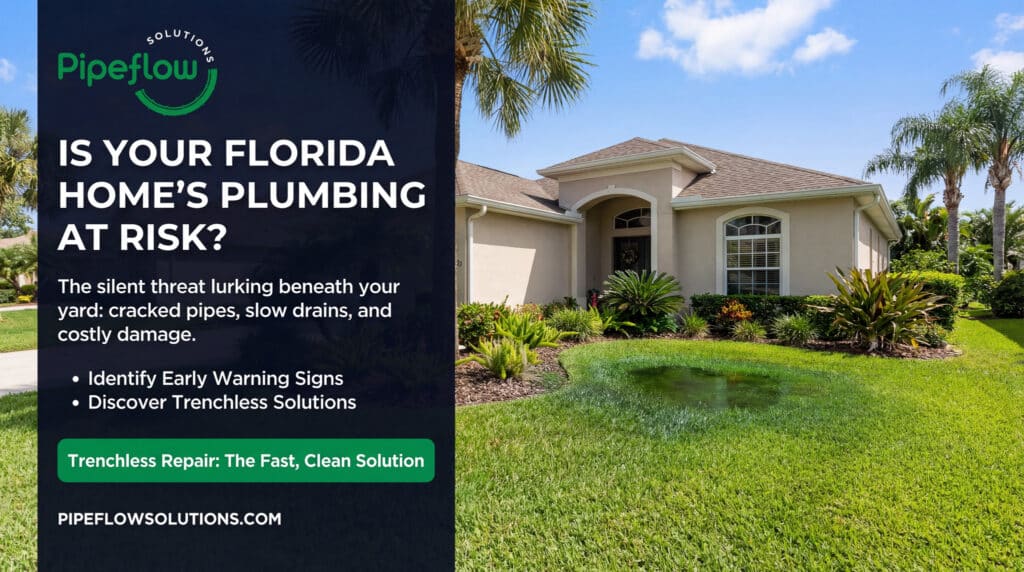
If you’ve been told your sewer line needs repair, the next question you’ll face is how it gets fixed. Two fundamentally different approaches exist: trenchless repair, which accesses and rehabilitates the pipe from the inside with minimal excavation, and traditional open-cut repair, which involves digging a trench along the pipe’s path to access it directly. Both can produce a durable, long-lasting result. The difference is everything that surrounds the repair itself — the cost, the timeline, and what your property looks like when the crew leaves.
Understanding how these two methods actually compare is the most useful thing you can do before you sit across from a contractor and review a proposal.
What Traditional Dig-and-Replace Actually Involves
Traditional sewer repair — sometimes called open-cut or dig-and-replace — is exactly what the name implies. A crew excavates the ground along the path of the damaged pipe, removes the failed section, installs new pipe, backfills the trench, and then restores whatever was on the surface. It’s a proven method with a long track record, and in certain situations it remains the right call. A fully collapsed pipe with no structural integrity left, a severe misalignment that can’t be corrected from the inside, or a pipe running through conditions that make trenchless access impractical — these are the scenarios where traditional excavation is the appropriate tool.
The challenge with dig-and-replace isn’t the pipe work itself. It’s the collateral. Accessing a sewer lateral that runs beneath a concrete driveway means cutting and removing concrete. Beneath a paver patio, those pavers come up. Beneath mature landscaping, roots get severed and plants get removed. In a finished interior space, it may mean cutting through flooring or walls. All of that gets repaired or replaced after the pipe is in — and that restoration work is a substantial portion of the total cost of the job, often representing as much as the pipe repair itself.
What Trenchless Repair Changes About the Equation
Trenchless sewer repair is an umbrella term for methods that rehabilitate or replace a damaged pipe without excavating along its full length. The two most common residential applications are:
- Pipe lining (CIPP), which installs a resin liner inside the existing pipe and cures it into a new pipe wall
- Pipe bursting, which pulls a new pipe through the old one while simultaneously fracturing and displacing the deteriorated pipe outward
Both require only small access points — typically at the existing cleanout or at each end of the section being repaired — rather than a trench running the entire length of the damaged line.
The practical consequence of this is significant. A sewer lateral running beneath a driveway, pool deck, hardscaped courtyard, or mature oak tree can be rehabilitated without touching any of those surfaces. The pipe gets fixed. The driveway stays intact. The oak tree survives. For Central Florida homeowners whose properties commonly have all of these features, this isn’t a minor convenience — it’s often the difference between a repair that costs $6,000 and one that costs $18,000 once surface restoration is factored in.
The Cost Comparison
Direct cost comparisons between trenchless and traditional repair are difficult to make in the abstract because the variables are significant — pipe length, depth, diameter, soil conditions, and what’s on the surface above all affect the final number. But the framework for thinking about cost is consistent regardless of the specific project.
Trenchless pipe lining on a standard residential lateral in Central Florida typically runs in the range of $4,000 to $12,000 depending on scope. That price is close to the all-in cost because there’s minimal surface restoration required. Traditional open-cut repair involves a pipe installation cost that may be comparable or even lower on a per-linear-foot basis, but the excavation, backfill, and surface restoration costs stack on top of it. Concrete cutting and replacement, paver removal and reinstallation, landscaping restoration, and interior finishing work are all real line items that add quickly. On a job where significant surface features sit above the pipe, total traditional repair costs can run two to three times the trenchless equivalent for the same pipe issue.
The one scenario where this math can flip is when the damage is so extensive — a fully collapsed pipe over a long run, or conditions that make liner adhesion unreliable — that traditional replacement is the only viable option. In that case, the cost comparison becomes irrelevant because trenchless isn’t actually on the table.
Timeline: One Day vs Several Days
For most residential sewer line repairs, a trenchless pipe lining job is completed in a single day. The camera inspection, pipe cleaning, liner installation, curing, and final inspection happen in one continuous workflow, and the home’s plumbing is typically back in service before the crew leaves. Pipe bursting jobs may extend to two days depending on the length and access conditions.
Traditional open-cut repair operates on a different timeline. Excavation, pipe removal and replacement, backfill, and compaction constitute the core work — typically one to three days for a standard residential lateral. The surface restoration that follows is a separate phase. Concrete work requires curing time before it can bear load. Landscaping replacement takes time to source and install. If the job involves interior work, drywall repair, painting, and flooring replacement add additional days. It isn’t unusual for the full cycle — from the day the crew arrives to the day the property looks normal again — to span one to two weeks.
For a homeowner with a family living in the house, this timeline difference matters practically. A one-day disruption and a two-week disruption are not equivalent experiences.
Property Impact: The Variable Most People Underestimate
Of the three comparison dimensions — cost, time, and property impact — property impact is the one that surprises homeowners most when they see traditional repair in practice. It’s easy to understand intellectually that a trench will be dug. It’s different to see a mature oak tree’s root system severed, a freshly paved driveway cut into sections, or a pool deck demolished to access pipe running beneath it.
Central Florida properties present this challenge more acutely than many other regions. Mature tree canopies over sewer lateral paths are common. Concrete and paver driveways and patios are near-universal. Many homes have pools, and pool decks frequently sit directly above lateral lines. When a homeowner is weighing trenchless versus traditional repair, the surface conditions above the pipe are often the deciding variable — not the pipe condition itself.
Trenchless methods leave all of that intact. The pipe is accessed through existing cleanout points or small excavations at the endpoints, and everything between those points stays undisturbed. For properties with significant surface improvements, this alone justifies the method independent of any other consideration.
When Traditional Repair Is Still the Right Answer
None of this is to suggest that trenchless repair is always superior. It isn’t. Traditional open-cut repair remains the correct choice when:
- A pipe has fully collapsed and has no remaining structure for a liner to bond to
- The pipe is severely misaligned or has a major belly that can’t be corrected from the inside
- Access conditions genuinely make trenchless methods impractical
- The pipe runs through open ground with no surface improvements above it, making excavation straightforward and inexpensive
A reputable sewer repair contractor will tell you honestly which method applies to your situation after a camera inspection. If you’re being quoted traditional repair without a camera inspection having been done first, that’s worth questioning. The inspection is what tells you whether a trenchless option is viable — and skipping it means the method recommendation isn’t actually based on the condition of your specific pipe.
People Also Ask
Is trenchless sewer repair as durable as traditional replacement?
Yes. Properly installed CIPP pipe lining is engineered to last 50 years or more, which is comparable to the lifespan of a new pipe installation. Pipe bursting installs a new pipe entirely. Neither trenchless method produces a result that is less durable than traditional open-cut replacement when the right method is applied to the right conditions.
Why would a contractor recommend traditional repair over trenchless?
Legitimate reasons include a fully collapsed pipe, severe misalignment, pipe conditions that make liner adhesion unreliable, or access situations that make trenchless methods impractical. If no camera inspection has been performed and traditional repair is being recommended, ask why trenchless isn’t being offered and what the inspection findings support.
Does trenchless repair work on all pipe materials?
CIPP lining is compatible with most common pipe materials including clay, cast iron, PVC, and concrete. Pipe bursting is similarly versatile. The pipe material is generally less of a limiting factor than the structural condition of the pipe — specifically whether enough of the original pipe structure remains intact to support a trenchless approach.
How much does it cost to repair a sewer line in Central Florida?
Costs vary significantly based on pipe length, depth, access conditions, and which method is appropriate. Trenchless pipe lining on a standard residential lateral typically ranges from $4,000 to $12,000. Traditional open-cut repair costs depend heavily on surface restoration requirements, which can match or exceed the pipe work itself on properties with concrete, pavers, or landscaping above the line.
Will trenchless repair disturb my landscaping or driveway?
In most cases, no. Trenchless methods access the pipe through existing cleanout points or small excavations at the endpoints of the repair section. The pipe is rehabilitated from the inside, leaving everything between those access points undisturbed — including driveways, pool decks, patios, and mature trees.
The Bottom Line
Trenchless and traditional sewer repair both fix the pipe. What they don’t share is the cost of getting there, the time it takes, or what happens to the property in the process. For most Central Florida homeowners — whose properties tend to have exactly the kind of surface improvements that make excavation expensive and disruptive — trenchless repair will be the more practical and cost-effective option when the pipe condition supports it.
The starting point for any sewer repair decision is a camera inspection. It’s the only tool that tells you what’s actually happening inside the line and whether trenchless methods are viable for your specific situation. From there, the comparison between methods becomes a clear, evidence-based conversation rather than a guess.