
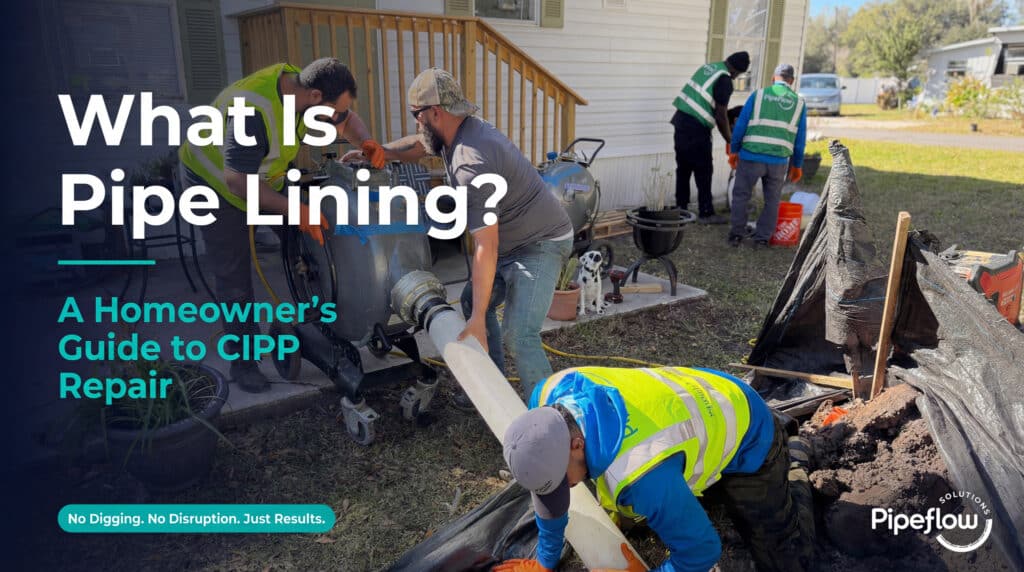
What Is Pipe Lining, Exactly?
Pipe lining is a trenchless repair technique used to fix cracked, corroded, or deteriorating sewer pipes without excavating the ground above them. Instead of digging up your landscaping, driveway, or flooring to access the pipe, a technician inserts a resin-saturated liner into the damaged line through a small access point—typically a cleanout or existing opening.
Once the liner is positioned correctly inside the old pipe, it’s inflated and the resin is cured (hardened) using hot water, UV light, or ambient air, depending on the method used. The result is a smooth, jointless “pipe within a pipe” that restores full flow capacity and seals off cracks, root intrusions, and joint failures.
If your plumber has mentioned “pipe lining” as an option for a damaged sewer line, you’re probably wondering what that actually means—and whether it’s really as simple as it sounds. The short answer: pipe lining, also called CIPP (cured-in-place pipe) repair, is a method of rehabilitating a damaged pipe from the inside without digging up your yard. A flexible liner is inserted into the existing pipe, inflated, and hardened in place, creating a durable new pipe within the old one.
It’s one of the most significant advances in residential plumbing of the last few decades—and for Central Florida homeowners dealing with aging clay, cast iron, or PVC lines, it’s often the most practical and cost-effective solution available.
Quick Definition: Pipe lining (CIPP) = a seamless epoxy or resin liner installed inside a damaged pipe and hardened in place, restoring structural integrity without excavation.
How Does CIPP Lining Work? The Step-by-Step Process
Understanding what happens during a pipe lining job helps you know what to expect as a homeowner. Here’s how the process typically unfolds:
- Step 1: Video Camera Inspection — Before any work begins, a technician runs a CCTV sewer camera inspection through the affected line. This confirms the location, type, and extent of the damage and rules out issues (like a fully collapsed pipe) that would require a different approach.
- Step 2: Pipe Cleaning — The line is thoroughly cleaned—usually with hydro jetting—to clear grease, debris, mineral buildup, and any root material. The liner needs a clean surface to bond to.
- Step 3: Liner Fabrication and Sizing — A felt or fiberglass tube is cut to the exact length of the damaged section and saturated with a two-part epoxy or polyester resin. The liner is sized to match the pipe’s diameter.
- Step 4: Insertion and Positioning — The resin-saturated liner is inserted into the pipe using an inversion drum or pull-in-place method. It’s carefully positioned to cover the full damaged area.
- Step 5: Inflation and Curing — An inflatable bladder expands the liner against the interior walls of the existing pipe. Heat, UV light, or ambient temperature triggers the curing process, hardening the resin into a rigid, smooth pipe.
- Step 6: Final Inspection — Once cured, the bladder is removed and another camera inspection confirms the liner has bonded correctly with no gaps, wrinkles, or missed sections.
The entire process—from camera inspection to final walkthrough—typically takes 4 to 8 hours for a standard residential line, depending on the length and condition of the pipe.
What Kinds of Damage Can Pipe Lining Fix?
CIPP sewer pipe lining is effective for a wide range of common pipe problems, including:
- Hairline cracks and fractures from ground movement or age
- Root intrusion where tree roots have penetrated joints or cracks
- Corroded pipe walls in cast iron or older clay lines
- Separated or offset joints where pipe sections have shifted
- Minor to moderate deterioration due to age and chemical buildup
However, pipe lining is not the right solution for every situation. If a pipe has fully collapsed, is severely misaligned, or has significant structural failure over a long stretch, trenchless pipe bursting or traditional open-cut replacement may be necessary. A thorough video inspection is the only reliable way to determine which method is appropriate for your specific line.
Pipe Lining vs. Pipe Replacement: What’s the Difference?
This is one of the most common questions homeowners ask when they’re weighing their options. Here’s a straightforward comparison:
| CIPP Pipe Lining | Traditional Replacement | |
|---|---|---|
| Excavation required | No | Yes |
| Disruption to landscaping | Minimal | Significant |
| Time to complete | 4–8 hours | 1–3 days or more |
| Best for | Partial damage, aging pipes | Full collapse, severe misalignment |
| Lifespan of repair | 50+ years | 50+ years |
| Cost | Typically lower | Often higher (labor + restoration) |
The key takeaway: when the pipe structure is still mostly intact—even if it’s cracked or corroding—trenchless pipe lining can deliver a repair that’s just as durable as replacement, at a lower overall cost and with far less disruption to your property.
How Long Does CIPP Lining Last?
This is a fair question, and the answer is reassuring: properly installed CIPP lining is engineered to last 50 years or more. The cured epoxy or resin material is highly resistant to corrosion, root intrusion, and chemical degradation. Because it creates a seamless, jointless pipe surface, there are no weak points at connections where future cracks are likely to develop.
Several municipalities across the country have used cured-in-place pipe repair on infrastructure lines for 30+ years with strong performance records. For homeowners, the technology is well-established and widely trusted.
Is Pipe Lining Right for Homes in Central Florida?
Florida’s soil conditions and climate create some specific challenges for residential sewer systems. Older homes throughout the Orlando area, Tampa Bay region, and surrounding Central Florida communities were commonly built with clay or cast iron sewer pipes—materials that degrade over time and are highly susceptible to:
- Root intrusion from mature oak, magnolia, and palm trees common in Florida landscaping
- Corrosion accelerated by Florida’s groundwater chemistry and humidity
- Joint displacement from Florida’s sandy, shifting soil
CIPP sewer pipe lining is particularly well-suited to these conditions. It seals root entry points, restores corroded walls, and creates a pipe that resists future chemical and biological degradation. And because it requires no digging, it preserves Florida’s notoriously difficult-to-restore landscaping and hardscape.
What Does Pipe Lining Cost?
Pipe lining costs vary based on the length and diameter of the pipe, the access conditions, and the extent of damage. As a general benchmark for Central Florida homeowners:
- Spot repair / short section: $1,500–$3,500
- Full residential lateral (standard length): $4,000–$12,000+
- Larger diameter or longer commercial lines: Priced separately based on scope
While the upfront cost of CIPP lining can feel significant, it’s important to factor in what you’re not paying for: excavation labor, pavement or landscaping removal, and the restoration of your yard or driveway after the job. Those costs add up quickly with traditional open-cut repair—and they’re essentially eliminated with a trenchless approach.
People Also Ask
What is the difference between pipe lining and pipe replacement?
Pipe lining rehabilitates the existing pipe from the inside without digging it up. Pipe replacement requires excavating the ground above the pipe and installing a completely new line. Lining is typically faster, less disruptive, and more affordable when the existing pipe still has its basic structural form intact.
How long does pipe lining last?
CIPP pipe lining is designed to last 50 years or more. The cured resin creates a corrosion-resistant, seamless pipe surface that holds up well against root intrusion, chemical exposure, and normal wear.
Does pipe lining work for all pipe materials?
Yes—CIPP lining is compatible with most pipe materials including clay, cast iron, PVC, and concrete. The liner adheres to the interior surface regardless of the host pipe material.
Can pipe lining fix root damage?
Yes. One of CIPP lining’s primary applications is sealing off the cracks and joint gaps where tree roots have entered the pipe. The hardened liner eliminates the entry points and restores full flow capacity.
Is pipe lining covered by homeowners insurance?
Coverage varies by policy and provider. Some homeowners insurance policies include sewer line coverage as an add-on rider. It’s worth reviewing your policy or speaking with your insurance agent before making repair decisions.
How do I know if my pipe can be lined instead of replaced?
A video camera inspection is the only reliable way to determine this. A licensed sewer repair technician will run a CCTV camera through the line to assess the damage type and severity before recommending a method.
The Bottom Line
Pipe lining—specifically CIPP (cured-in-place pipe) repair—is a proven, long-lasting solution for damaged sewer lines that doesn’t require tearing up your property to get the job done. For Central Florida homeowners dealing with aging clay or cast iron pipes, root intrusion, or corrosion, it’s one of the most effective and cost-efficient repairs available.
If you’ve been told you have a sewer line problem, the first step is always a video inspection to understand exactly what you’re dealing with. From there, a qualified trenchless repair specialist can tell you whether pipe lining is the right fit—or whether another approach makes more sense for your situation.