
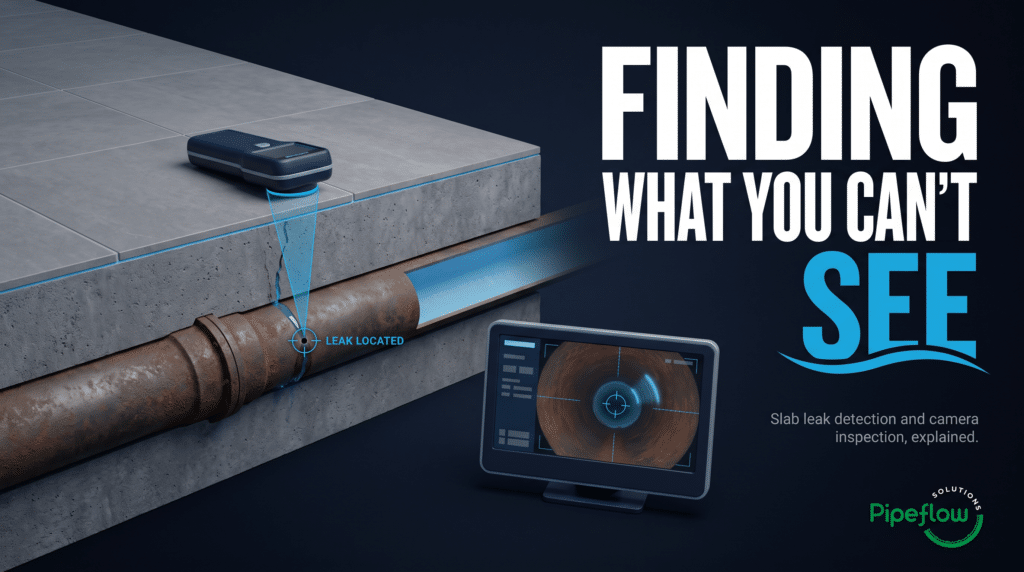
Plumbers detect a slab leak by isolating the water system, then narrowing the leak’s position with a combination of pressure testing, acoustic listening, thermal scanning, and camera pipe inspection. Each method rules out possibilities until the leak is located to within a small area of the slab. Nothing gets opened up until the location is confirmed.
That last point matters more than most homeowners realize. Accurate slab leak detection is what keeps a repair small. A leak located to within a foot or two becomes a targeted repair. A leak that is only guessed at becomes a series of exploratory holes in your flooring.
Below is how the process actually works in Central Florida homes and buildings, and what happens after the leak is found.
What a Slab Leak Actually Is
A slab leak is a leak in a water supply line or drain line that runs beneath or through a concrete foundation slab. In most Orlando-area homes built before the 1980s, those lines are cast iron for drainage and copper or galvanized steel for supply. Both corrode from the inside out over decades.
Florida conditions accelerate the problem. High water tables, sandy soil that shifts under slabs, and year-round humidity all put stress on buried pipe. Cast iron drain lines in particular lose wall thickness from the bottom up, which is why the failure is often invisible until water appears.
Common signs a slab leak is developing include:
- A water bill that climbs with no change in usage
- Warm or damp spots on the floor, especially with a hot water line leak
- The sound of running water when every fixture is off
- Cracking or lifting in tile, wood, or vinyl flooring
- A musty smell near baseboards or in a closet
- Foundation cracks or doors that stop closing squarely
Any one of these justifies an inspection. Several together usually mean water has been moving under the slab for a while.
How Plumbers Detect a Slab Leak: The Six-Step Method
Professional slab leak detection follows a sequence. Each step narrows the search area before anyone touches the concrete.
- Isolate the system and confirm a leak exists. The main supply is shut at the meter and the meter dial is watched. Continued movement with all fixtures closed confirms water is escaping somewhere in the supply system.
- Pressure test to identify which line is failing. The supply lines are isolated and pressurized with air or water, then monitored for pressure drop. This separates a supply leak from a drain leak, and hot side from cold side, which cuts the search area substantially.
- Trace the pipe route. A line tracer or pipe locator maps where the pipes actually run under the slab. As-built drawings are often missing or wrong, and this step prevents cutting in the wrong place.
- Use acoustic leak detection to listen for the escape point. Ground microphones and amplified listening equipment pick up the sound of pressurized water escaping a pipe. Under concrete, that sound has a distinct signature, and the technician moves the sensor across the floor until the signal peaks.
- Apply electronic and thermal confirmation. Electronic leak detection equipment reads variations in moisture and signal behavior through the slab. Infrared thermal imaging finds the temperature difference created by escaping hot water. Together they confirm what acoustics suggested.
- Run a camera pipe inspection to see the pipe itself. A drain line problem is confirmed visually. A camera on a flexible cable is fed through a cleanout, and a locating transmitter on the camera head marks the exact depth and position of the defect from above the slab.
Not every job needs all six steps. A straightforward hot water supply leak may be located with pressure testing and acoustics alone. A cast iron drain failure almost always needs the camera.
Acoustic vs. Electronic vs. Camera: What Each Method Sees
These tools answer different questions, which is why non-invasive leak detection works best when they are used together.
Acoustic Leak Detection
Best for pressurized supply lines. Escaping water under pressure makes noise, and that noise travels through concrete and soil. Acoustic equipment excels at pinpointing supply leaks but cannot hear a drain line, because drain lines are not under pressure.
Electronic and Thermal Detection
Best for confirming and refining. Thermal imaging is especially effective on hot water lines and on slabs where moisture has spread. It shows the extent of saturation, which tells you how long the leak has been running.
Camera Pipe Inspection
Best for drain and sewer lines, and the only method that shows you the pipe’s actual condition. A camera distinguishes between a single crack, a section of corroded pipe, a root intrusion at a joint, and a length of cast iron that has lost most of its bottom wall. That distinction determines the repair.
Pipeflow Solutions uses state-of-the-art camera technology to identify blockages, leaks, and wear without excavation. You can see how our video pipe inspections work and what the footage reveals about pipe condition.
Why Detection Alone Is Only Half the Job
Plenty of companies will locate your slab leak and hand you a report. That report tells you where the leak is. It does not tell you whether the surrounding pipe is sound, and it does not fix anything.
This is where the camera earns its value. A leak at one joint in a 60-year-old cast iron line usually means the rest of that line is at a similar stage of corrosion. Spot-repairing a single point on a system that is failing along its length means you will be back inside your slab within a few years.
A proper inspection produces three answers, not one:
- Where the leak is, to a specific location and depth
- Why it failed, whether corrosion, joint separation, shifting soil, or root intrusion
- What condition the rest of the line is in, and how much of it needs attention
Detection and repair belong in the same conversation. When one company does both, the inspection is designed to inform the repair method rather than just close a service call.
From Detection Straight Into Trenchless Repair
Once the leak is located and the pipe’s condition is documented, most slab leaks can be corrected without breaking up the floor. That is the core of trenchless pipe rehabilitation.
Depending on what the camera shows, the options generally include:
- Cured-in-place pipe lining. A resin-saturated liner is installed inside the existing pipe through an access point and cured in place, forming a new pipe wall within the old one. No trenching across the slab.
- Pipe bursting or pipe replacement. Used where the host pipe is too deteriorated to line, with access limited to entry and exit points instead of a full excavation.
- Rerouting. Where a supply line is failing in multiple places, the line is rerouted through walls or attic space and abandoned under the slab.
- Targeted spot repair. Appropriate when the camera confirms an isolated defect in an otherwise sound line.
The right choice depends entirely on the inspection findings, which is why the detection step deserves care. Good data produces a smaller, more durable repair.
What to Expect During a Slab Leak Detection Visit
A typical residential detection visit follows a predictable rhythm. Knowing it helps you prepare.
- The technician reviews your symptoms, water bill history, and the age and construction of the home.
- Fixtures are checked first, because a running toilet or failed valve mimics a slab leak and costs nothing to rule out.
- The meter test and pressure test establish whether the leak is on the supply or drain side.
- Acoustic, electronic, and thermal equipment narrows the location, with the technician working across floors, walls, and any accessible cleanouts.
- A camera inspection documents drain line condition where relevant.
- You receive the location, the cause, and the repair options that fit the findings.
Clear access helps. Moving furniture off the suspected area, keeping pets in another room, and identifying where your cleanouts are all shorten the visit. Quiet also matters, since acoustic work depends on listening for faint sound through concrete.
Slab Leak Detection in Orlando and Central Florida
Central Florida has a large stock of homes and multi-family buildings from the 1950s through the 1970s, which puts a great deal of cast iron and copper right at the end of its service life. Add sandy soil, seasonal water table movement, and heavy summer rainfall, and slab leaks are among the most common calls we take.
Pipeflow Solutions is state licensed under CFC1433047, fully insured, and backed by more than 75 years of combined experience across residential, commercial, municipal, and multi-family systems. We locate the leak, show you the pipe on camera, and carry out the trenchless repair in-house.
If you are seeing an unexplained water bill, a warm patch on the floor, or flooring that has started to lift, an inspection now is far less disruptive than a repair after the water has spread. Contact Pipeflow Solutions to schedule slab leak detection in Orlando and Central Florida.